
Direct answer
Fix duplicate content on WordPress by deciding what each extra URL is for. Redirect it when it should not exist, add a canonical tag when it must stay live, and noindex it when it should not appear in search. Then check it in Search Console. Most duplicates come from archives, tags and attachment pages.
What is duplicate content?
Duplicate content means the same content, or substantially similar content, appears at more than one URL, per wbcomdesigns.com. It does not have to be word-for-word identical. If two URLs serve content that Google considers equivalent, the same text, the same structure, the same topic with minor variations, that is duplicate content from Google’s perspective, per msangeetha.com. It can happen on your own website, or it can happen when other websites copy your content, per pulsfi.com.
When Google encounters the same content at multiple URLs, it must choose which version to include in its index and display in search results, per wbcomdesigns.com. Google groups URLs with essentially the same page content and selects one as canonical, the URL it treats as the representative version, per umatechnology.org. That is the whole problem: Google has to guess, and when it guesses, your ranking signals split across the duplicate URLs instead of landing on one page.
Here is the good news. Duplicate content is not a penalty. Google has been clear about this for years, per msangeetha.com. Duplicate content is not automatically a violation of Google’s spam policies, per seovixo.com. For ordinary duplication like URL variants and syndicated posts, there is generally no penalty. Google simply picks one version to index and consolidates signals, per amplifi.studio. The real costs are indirect: ranking signals split across duplicate URLs, and Google spends its crawl budget on copies instead of your real pages.
Where does WordPress create duplicates?
Most of the duplicates on a WordPress site are not something you wrote. WordPress creates them on its own, through its default settings. Without deliberate configuration, Google indexes all of them as separate pages competing with your original content, per msangeetha.com. WordPress does it automatically, per msangeetha.com. This does not mean your site is broken or that you have done something wrong. It means WordPress’s default settings were not designed with modern SEO in mind, and a bit of deliberate configuration fixes most of it in under an hour, per msangeetha.com.
| Duplicate source | What WordPress does | Why it hurts |
|---|---|---|
| Category archives | A separate page for every category assigned to a post | Each archive repeats the same post excerpts |
| Tag archives | A separate page for every tag assigned to a post | Dozens of thin pages that compete with your posts |
| Author archives | A page listing every post by one author | Repeats the same posts under a different URL |
| Date archives | A page for every month and year with posts | More copies of the same post list |
| Attachment pages | A page for every image you upload | A bare page with one image and no real content |
| URL parameters | Tracking links like ?utm_source=facebook | Add ?utm_source=facebook to any post URL and you have technically created a distinct URL serving identical content, per amplifi.studio |
| www and https versions | The same site on www, non-www, http and https | Parallel copies of your entire site |
WordPress’s redirect_canonical() handles the slash mismatch with a 301, so /post and /post/ usually converge on their own, per awplife.com. The rest need your attention, and the fixes below are in priority order, so you can focus on what actually moves the needle first, per msangeetha.com.
How do you find duplicates on your site?
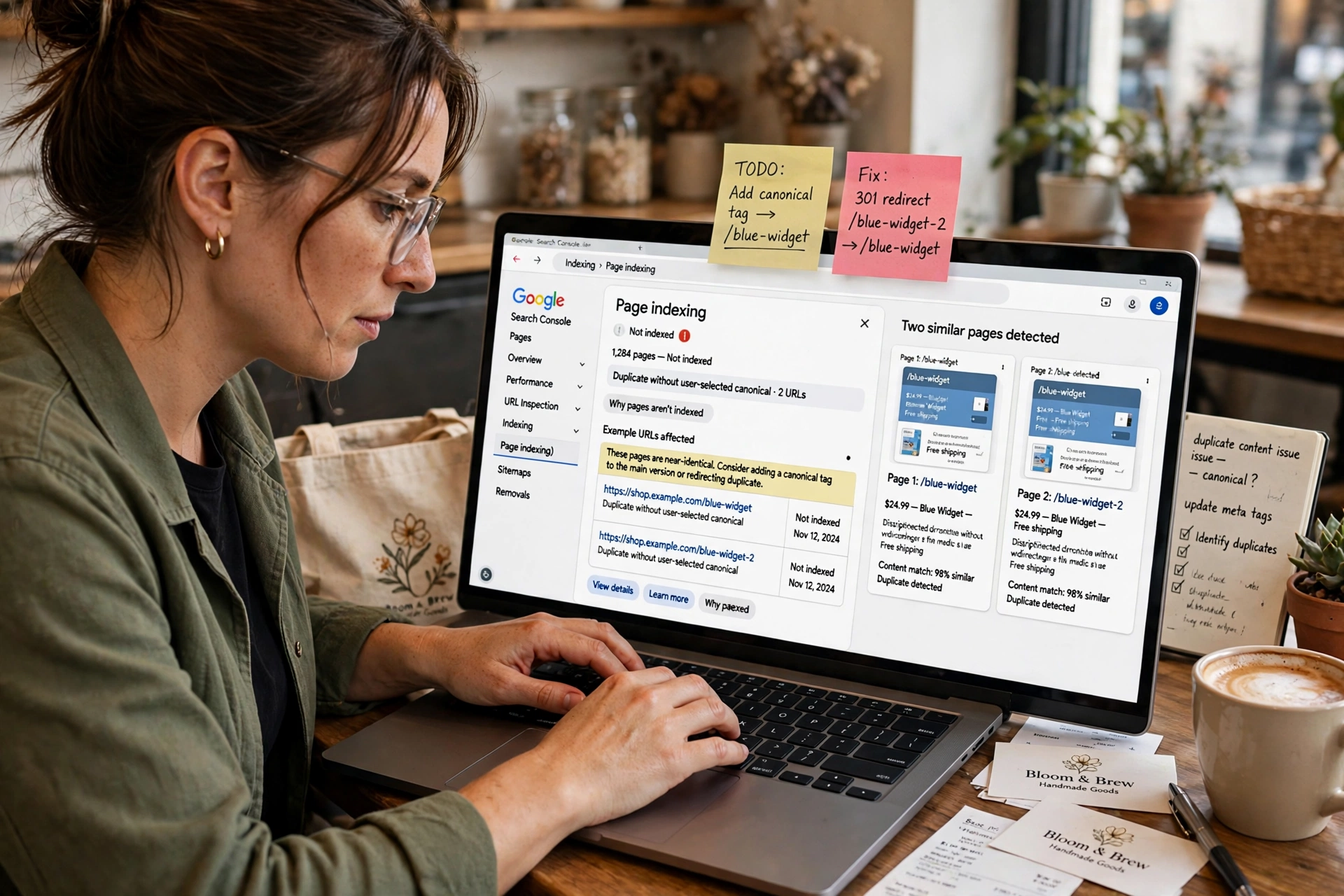
Start with Google Search Console. It shows you exactly which URLs Google has discovered and what it decided to do with them, per completenursingsolution.in. Go to Indexing, then Pages, in the left menu and look at the “Why pages aren’t being indexed” section, per completenursingsolution.in. Open Google Search Console and review the Page indexing report for messages such as “Duplicate without user-selected canonical” or “Google chose different canonical than user”, per seovixo.com.
Those two messages are the ones to look for. “Duplicate without user-selected canonical” means Google found a copy and you did not tell it which version is the original. “Google chose different canonical than user” means you did tell it, and Google disagreed. Both are worth reading. To learn what the four numbers mean and how to read the reports together, read our guide on how to measure SEO results in Google Search Console.
For a single page, use the URL Inspection tool at the top of Search Console. Enter the address of a page, and it will show you the canonical Google selected for it, the last crawl date, and whether there are any errors on it. Use Search Console URL Inspection to review Google’s selected canonical when data becomes available, per seovixo.com. Do not change redirects or canonical tags simply because a report contains the word “duplicate”, per seovixo.com. Read the page first, decide what it is for, and then pick the fix.
Which fix should you choose?
Every duplicate in WordPress falls into one of three buckets, and each has a different fix. Getting this order wrong is why “I added canonicals and nothing changed” happens, per awplife.com. Decide first, then act.
| Situation | Fix | Why |
|---|---|---|
| The second URL should not exist | 301 redirect | Removes the duplicate instead of describing it |
| The second URL must exist | Canonical tag | Consolidates while keeping the URL functional |
| The page should not be in search at all | noindex | Blocks indexing entirely, not just consolidation |
The rule in one line: redirect when the duplicate is an accident, canonicalise when it is a necessity, noindex when the page has no business ranking, per awplife.com. A canonical tag is the correct tool for part of this problem and the wrong tool for the rest, per awplife.com.
Fix 1: Redirect what should not exist
A 301 redirect is suitable when a page has moved, an old URL has been replaced, or two substantially overlapping articles have been consolidated into one, per seovixo.com. When duplicate content exists because of old URLs, website migrations, or structural changes, 301 redirects permanently redirect traffic and ranking signals from the old URL to the correct one, per wbcomdesigns.com.
The most common case on a small site is an old slug. If you changed a page’s URL, old links might still exist somewhere. Use a 301 redirect to send visitors and search engines from the old link to the new one, per pulsfi.com. WordPress does this for you automatically when you change a slug in the editor: the old slug redirects to the new one. That is the same mechanism this site uses every time a post is rewritten under a new title.
The www and https versions need the same treatment. If your site answers on both www and the bare domain, or still responds on http, you have parallel copies of your entire site, per amplifi.studio. The right fix is not a canonical tag on each page. It is a server-level 301 redirect that forces everyone onto one host and HTTPS, per amplifi.studio. Set your WordPress Address and Site Address in Settings, then General, to the exact canonical form, and make sure your host or server config redirects the alternatives, per amplifi.studio. Canonical tags are a backstop here, not the primary tool.
Do not redirect every duplicate URL to the homepage or to a page with a different purpose. The destination should be the most relevant replacement, per seovixo.com. A redirect to an unrelated page tells Google the old page is gone and the new page is not its replacement, so the ranking signals do not transfer.
Fix 2: Canonicalise what must stay
A canonical tag tells Google which URL is the original when several URLs serve substantially the same content, per awplife.com. It does three things and only three: it suggests which URL should be treated as primary, it consolidates ranking signals toward that URL, and it reduces crawl waste, because duplicates get crawled less often once clustered, per awplife.com. It does not remove the duplicate from the index, does not block anything, and does not guarantee Google will agree, per awplife.com. Google is explicit that it is a preference rather than an instruction. In its canonicalization documentation, “indicating a canonical preference is a hint, not a rule”, per awplife.com.
Most SEO plugins, like Yoast SEO or Rank Math, add canonical tags automatically, per pulsfi.com. WordPress core already prints a self-referencing canonical on single posts and pages through its rel_canonical() function, per aiwebpageseo.com. Since WordPress 2.9, released in 2009, core has included a function called rel_canonical() that hooks into wp_head and prints a self-referencing canonical tag on singular views, individual posts, pages, and custom-post-type entries, per amplifi.studio. The function only fires on is_singular() views. Your homepage, category and tag archives, author archives, date archives, and search results pages get no core canonical tag at all, per amplifi.studio. SEO plugins replace that output with their own and extend it to archives, categories and the home page, per aiwebpageseo.com.
So on most WordPress sites you are not adding a canonical. You are checking and correcting the one the plugin prints, per aiwebpageseo.com. To set a custom one in Yoast SEO, edit the post or page, open the Yoast SEO panel, choose the Advanced section and fill in Canonical URL, per aiwebpageseo.com. Leave it empty for a normal self-referencing canonical. Only enter an address when this page is a duplicate of another, per aiwebpageseo.com. In Yoast SEO, open the Yoast sidebar in the editor, go to Advanced and enter the full URL in the Canonical URL field, including https and the right www or non-www version, per octopusmarketing.agency.
Three implementation rules come straight from Google’s consolidate duplicate URLs page and get skipped constantly, per awplife.com. First, the canonical URL must be indexable. If it 404s, redirects, or carries noindex, the hint fails. Second, use absolute URLs. Relative paths work, but Google does not recommend them. Third, put a self-referencing canonical on the canonical page. The page you point everything at should canonically point at itself. Otherwise you have created an open question, per awplife.com.
Use a canonical tag when duplicate URLs must stay live for users but only one should rank, per octopusmarketing.agency. Typical cases are tracking links, print versions, sorted or filtered listings, and product variants that do not deserve their own result, per aiwebpageseo.com. A canonical tag is not a way to merge two different pages, and it does not hide a page from visitors. If an old page should never be visited again, a 301 redirect is the honest answer, per aiwebpageseo.com.
Fix 3: Noindex the archives that should not rank
For pages that need to exist for users but should not appear in search results, the noindex meta robots directive prevents indexing without removing the page, per wbcomdesigns.com. WordPress creates a separate archive page for every category and tag you assign to a post, per completenursingsolution.in. To fix this, you should noindex your tag archives because this removes them from Google’s index without deleting the pages or affecting your site structure, per completenursingsolution.in.
In Yoast SEO, go to Yoast SEO, then Settings, then Content types, and set the archive types you do not want in search to not show. The same setting exists for categories, tags, author archives and date archives. Set tag archives to noindex, set author archives to noindex, set date archives to noindex, per msangeetha.com. That one change removes dozens of thin competing pages from Google’s index in a single afternoon.
Do not noindex your category pages blindly. A category page with a real description and a clear purpose can rank and bring in traffic. Review category pages individually, per msangeetha.com. If a category page is just a list of posts with no description, noindex it. If it has a useful introduction and a clear topic, keep it in search and write a proper description for it. The same judgement applies to author pages: a single-author site has no need for an author archive at all, while a multi-author site may want one.
Fix 4: The five quick settings that fix most of it
If you want to fix most WordPress duplicate content issues quickly, per msangeetha.com, work through this list in order. It takes under an hour, and it covers the duplicates that affect virtually every WordPress site by default, per msangeetha.com.
| Setting | Where to change it | What it does |
|---|---|---|
| Tag archives to noindex | Yoast SEO, Settings, Content types | Removes thin tag pages from search |
| Author archives to noindex | Yoast SEO, Settings, Content types | Removes the author copy of your posts |
| Date archives to noindex | Yoast SEO, Settings, Content types | Removes the monthly copies of your posts |
| Attachment URL redirect | Yoast SEO, Settings, Advanced | Sends image pages to the parent post |
| HTTPS and one domain version | Settings, General, plus a server 301 | Stops the www, non-www, http and https copies |
Set tag archives to noindex, set author archives to noindex, set date archives to noindex, enable attachment URL redirect, ensure HTTPS plus a single domain version, and review category pages individually, per msangeetha.com. For attachments, the common pattern is to redirect the attachment page to its parent post, per awplife.com. Yoast SEO has a setting for this under Settings, then Advanced: redirect attachment URLs to the attachment itself or to the parent post. Choose the parent post.
After those five, check your internal links. Internal links should point to the preferred canonical URLs rather than alternate versions, per seovixo.com. If your own navigation and your own posts link to the tracking version of a URL, or to the http version, you are telling Google that version matters. Good internal linking for SEO means every link on your site points to the one version you want Google to index. That habit is part of the same job as the technical fixes above, and it is covered in full in our technical SEO checklist for WordPress beginners.
What should you never do?
The one thing never to do is use robots.txt for this, per awplife.com. Blocking a URL in robots.txt stops Google from crawling it, which also stops Google from reading the canonical tag you put on it. You end up with an uncrawled duplicate and no signal, per awplife.com. Google is direct about two tools. Its guide says do not use robots.txt for canonicalization, and do not use the URL removal tool for it either, per octopusmarketing.agency.
Do not rely on a sitemap alone to fix duplicate URLs. Redirects and canonical tags are stronger canonicalization signals, and Google considers several signals when choosing a representative page, per seovixo.com. A sitemap helps Google discover your pages, but it does not tell Google which version is the original.
Do not use noindex to stop a page from being chosen as canonical within one site, per octopusmarketing.agency. Google does not recommend it. If two pages are true duplicates, pick one as the canonical and redirect or canonicalise the other. Noindex is for pages that should not be in search at all, not for choosing between two copies of the same content.
How do you check that it worked?
Wait at least a few days after a change before you judge it. Google needs to crawl the changed pages before the reports update. Then open Search Console, go to Indexing, then Pages, and check whether the “Duplicate without user-selected canonical” messages are falling. Open the URL Inspection tool for the pages you changed and check which canonical Google selected. If it matches the one you set, the fix worked. If it does not, read the page again: Google may have picked a different canonical because your internal links, your sitemap or your redirects point somewhere else. Google treats rel=”canonical” as a strong signal, not an order it must obey, per amplifi.studio. Google’s own documentation is explicit that it uses canonical tags as one signal among several, redirects, sitemap contents, a preference for HTTPS, and how you link across your own pages, when choosing which URL to index, and it can pick a different canonical than the one you specified, per amplifi.studio.
If the numbers do not move after two weeks, work through the list again. The most common cause is a conflicting signal: a canonical pointing one way, an internal link pointing the other, and a sitemap listing a third version. Make every signal point at the same URL, and Google will follow.
Frequently asked questions
Is duplicate content a Google penalty?
No. Duplicate content is not a penalty. Google has been clear about this for years, per msangeetha.com. For ordinary duplication like URL variants and syndicated posts, there is generally no penalty. Google simply picks one version to index and consolidates signals, per amplifi.studio. The cost is indirect: split ranking signals and wasted crawl budget.
What is the difference between a canonical tag and a 301 redirect?
A canonical tag is a hint that tells Google which version is the original, while the duplicate URL stays live, per awplife.com. A 301 redirect removes the duplicate URL entirely and sends visitors and ranking signals to the correct one, per wbcomdesigns.com. Redirect when the duplicate should not exist. Canonicalise when it must stay live.
How do I set a canonical URL in Yoast SEO?
Edit the post or page, open the Yoast SEO panel, choose the Advanced section and fill in Canonical URL, per aiwebpageseo.com. Leave it empty for a normal self-referencing canonical. Only enter an address when this page is a duplicate of another.
Should I noindex my tag and category pages?
Noindex your tag archives, because they are thin copies of your posts, per completenursingsolution.in. Review category pages individually, per msangeetha.com. Keep a category page in search if it has a real description and a clear purpose. Noindex it if it is just a list of posts.
Why does Google ignore my canonical tag?
Because a canonical preference is a hint, not a rule, per awplife.com. Google weighs redirects, internal links, the sitemap and whether the pages are truly duplicates, per aiwebpageseo.com. If your tag disagrees with everything else, Google may pick a different URL, per aiwebpageseo.com.
How do I find duplicate content on my site?
Open Google Search Console and review the Page indexing report for messages such as “Duplicate without user-selected canonical” or “Google chose different canonical than user”, per seovixo.com. For a single page, use the URL Inspection tool to see which canonical Google selected.
Conclusion
Duplicate content on WordPress is mostly a settings job, not a writing job. WordPress creates the copies on its own, through archives, tags, attachment pages and URL parameters, and a few settings fix most of them in under an hour. Decide what each extra URL is for, then redirect the ones that should not exist, canonicalise the ones that must stay live, and noindex the ones that should not appear in search. Make every signal point at the same URL: your links, your sitemap, your canonical tags and your redirects. Then check the result in Search Console and wait. The duplicates will fall away, and the ranking signals that were split across copies will land on the one page you want Google to show.