
Direct answer
Start an email list by picking one email tool, deciding what you will send, offering one clear reason to join, and putting a short signup form where your visitors already are. Ask your existing customers first, send a welcome email to every new subscriber, and email once a week on the same day. Never buy a list.
What is an email list, and why start one?
An email list is a list of people who gave you their email address and said yes to hearing from you. It is the one audience you actually own, a direct line to people who already raised their hand and said they want to hear from you, per blog.blakebusinessservices.com. You can take it to any tool, and no platform can switch it off.
That ownership is what makes a list worth building. Your social media followers belong to the platform. Your search rankings belong to Google. Your email list belongs to you. If a platform changes its rules or closes your account, your followers stay there. Your list moves with you, to any tool, at any time.
The money follows the same logic. With an average ROI of $36 for every $1 spent, email delivers better returns than social media or paid ads for most industries, per goodfellastech.com. According to the Email Tool Tester, email marketing can return $36 for every $1 spent, per hosted.com. Email can return $36 to $42 for every $1 spent, per businessanywhere.io. Those are averages across many businesses, not a promise for your shop, but they show why a list is the first marketing asset a small business should build, before adverts and before a big social media effort.
What will you send?
Before you collect a single address, answer one question: what will land in their inbox, and why would they be glad to see it? per blog.blakebusinessservices.com. You do not need a grand content plan. Pick a simple, honest promise you can keep, such as a short monthly note with a genuinely useful tip and what is new, per blog.blakebusinessservices.com.
The promise is what makes people join, and it is what keeps them reading. A list built on a vague promise, such as “subscribe for updates”, will grow slowly and lose people fast. A list built on a clear promise, such as “one short tip a week for saving money on heating bills”, will grow faster and keep its readers, because every email delivers what was promised.
Write the promise down in one line before you do anything else. Then check every email you send against it. If an email does not deliver on the promise, do not send it. That one habit will keep your list healthy for years.
Once you know what you will send, learn the rest of the system in our guide to email marketing for small business beginners. It covers the welcome sequence, the weekly schedule and the numbers that matter, and this guide covers how to build the list itself.
How do you give people a reason to join?
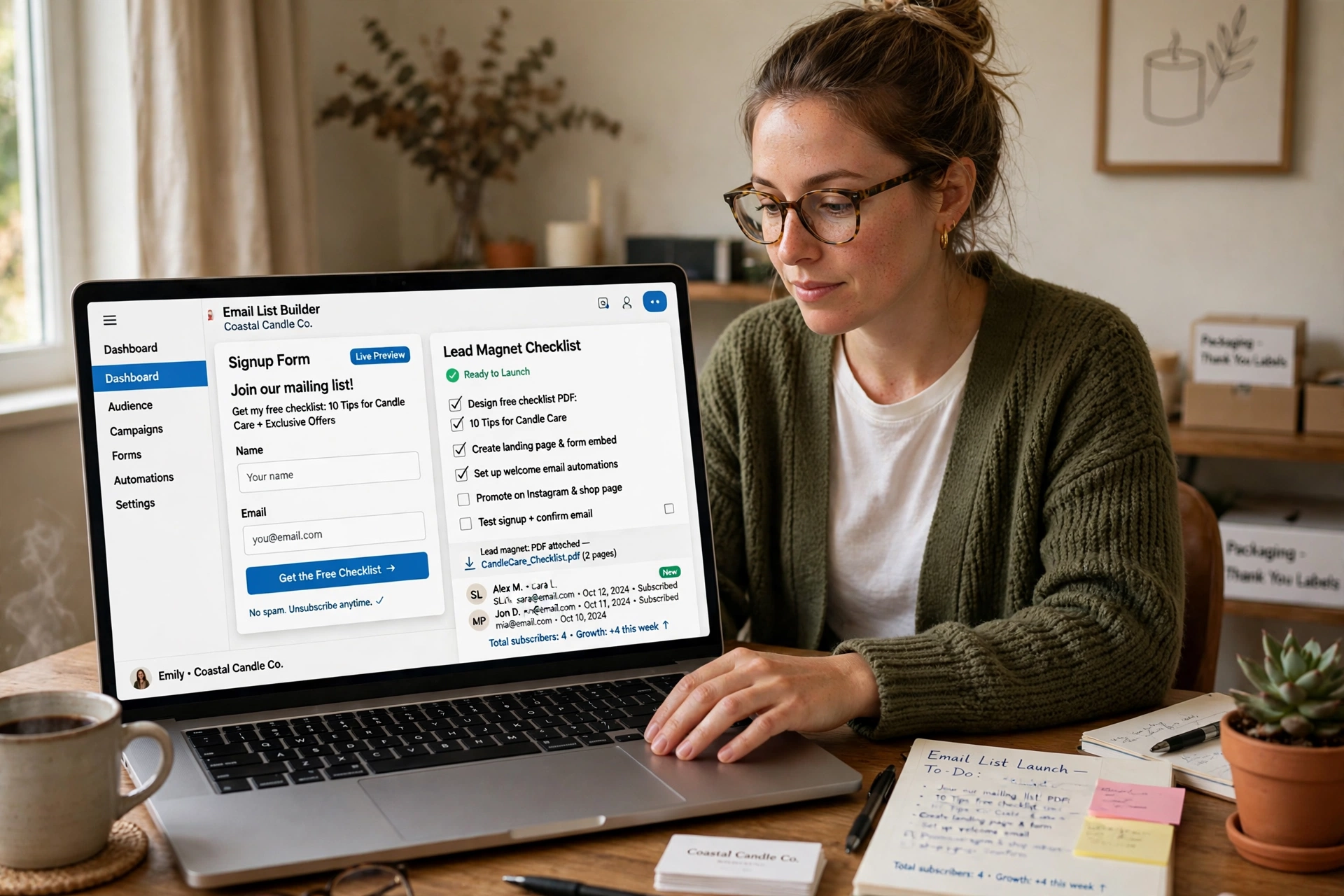
Nobody joins a list for nothing. People join because you offer them something clear in return. The classic version is a lead magnet, a small, useful thing people get in exchange for their email, per blog.blakebusinessservices.com. Offer a lead magnet such as a free guide, a checklist or a first-order discount, per goodfellastech.com.
| Lead magnet | What it is | Best for |
|---|---|---|
| A short guide | A 2 to 3 page PDF that answers one common question | Service businesses and shops with expert knowledge |
| A checklist | A one page list a customer can print and use | Trades, home services and product shops |
| A first-order discount | 10 percent off the first order when you join | Shops and online stores |
| A template | A simple form or planner the customer fills in | Business services and consultants |
| Early access | First chance at a new product, a sale or a booking slot | Seasonal businesses and makers |
Keep the lead magnet small and useful. A 20 page guide will never be finished, and a vague offer will never be claimed. A one page checklist that solves a real problem is better than a long guide nobody reads. Make it in an afternoon, test it with five customers, and improve it if they do not want it.
Your call to action should tell people what they get. “Get 10 percent off your first order when you join our email list” is much stronger than a plain “Subscribe”, per businessanywhere.io. Put the offer in the button itself, not just next to it. The button should say what the reader gets, in plain words.
How do you pick one tool and set it up?
You need an email marketing tool, not your personal inbox. Sending bulk mail from a normal Gmail or Outlook account gets you flagged as spam, gives people no clean way to unsubscribe, and breaks the law in most places, per blog.blakebusinessservices.com. A proper tool handles signup forms, unsubscribes and deliverability for you.
| Tool | Free plan | Starting price | Best for |
|---|---|---|---|
| Mailchimp | Free up to 500 contacts | About $13 a month | A small business starting from zero |
| MailerLite | Free for a small list | Low monthly fee | A business that wants a simple editor |
| Brevo | Free plan with a daily send limit | Low monthly fee | A business with many contacts and a small budget |
| Constant Contact | Trial only | About $12 a month | A business that wants simple setup and support |
Mailchimp is great for small businesses with fewer than 500 contacts, with a drag-and-drop editor, basic automation and templates, per goodfellastech.com. Mailchimp and MailerLite are both excellent platforms for beginners, per goodfellastech.com. Mailchimp is free up to 500 contacts, per goodfellastech.com, and its starting price is about $13 a month, per businessanywhere.io. Constant Contact offers a trial only, with a starting price of about $12 a month, per businessanywhere.io.
Pick one tool, set it up once, and do not switch for a year. Sign up for the free plan, create one signup form, and connect it to your website. Send a test email to yourself before you invite anyone to join. The setup takes an afternoon, and most reputable tools are free up to a few hundred or a thousand contacts, which covers your first year or more, per blog.blakebusinessservices.com.
How do you start with the people you already know?
You almost certainly have a starting list already. You just have not assembled it yet, per sendflo.io. Go through your phone contacts, your WhatsApp chats, and your last six months of invoices. Most small businesses already have 50 to 200 email addresses sitting in those three places, per sendflo.io. That is enough to start your first campaign today.
Go through your phone contacts, meaning people you have already spoken with, your WhatsApp chats, meaning anyone who has placed an order or asked a question, and your invoices from the last six months, per sendflo.io. You will probably find 50 to 200 people right there. Add them to a spreadsheet, then import them into your email tool. These people already know you.
Do not add them to your marketing list without asking. Always get explicit consent before adding someone to a marketing list. Sending unsolicited email, even to past customers, without their agreement is a GDPR violation in many countries and will hurt your deliverability, per sendflo.io. Send a personal message to your top 20 customers asking if they would like to be on your mailing list for offers and updates. Most will say yes, and a personal ask converts far better than any signup form, per sendflo.io.
That personal ask is the fastest way to your first 100 subscribers. A form on your website will bring a few signups a week. A message to 20 customers who already trust you can bring 15 signups in a day. Do both, but start with the people you know.
Where do you put signup forms?
A list grows where you have attention. Place a clear, single-purpose signup prompt at each point people meet your business, per blog.blakebusinessservices.com. Put signup forms in blog posts, headers, footers and well-timed popups, per goodfellastech.com. Place signup forms where people are already looking: your homepage, product or service pages, blog posts, and footer, per businessanywhere.io. A dedicated signup page can work well too, per businessanywhere.io.
Keep the form short. In most cases, name and email are enough, per businessanywhere.io. Two fields in your footer, name and email, is enough, per sendflo.io. The key is the copy next to it, per sendflo.io. Every extra field you ask for loses signups, so ask for the email first and nothing else until the person is on your list.
Collect emails at every purchase, per sendflo.io. At online checkout, add an unchecked opt-in box with plain language such as: “Yes, email me offers, updates, and event invites.” Never pre-check it, per businessanywhere.io. An unchecked box means the customer chose to join, and that choice is what keeps your emails out of the spam folder.
Use your social media following too, per sendflo.io. Put the signup link in your profile, in your stories, and at the end of posts that got a good response. Ask for referrals from your existing subscribers, per sendflo.io, and run a giveaway or contest, per sendflo.io, when you want a burst of signups. A giveaway brings fast signups, but check that the people who join want your emails, not just the prize.
What rules keep you out of trouble?
Ask for consent with a checkbox and link your privacy policy, per goodfellastech.com. Do not buy lists: they bring bounces, spam complaints and legal risk under GDPR or CAN-SPAM, per goodfellastech.com. Never buy or scrape lists. Bought contacts did not ask to hear from you, they mark you as spam, and that wrecks your deliverability for everyone, including the people who did opt in. It also breaks consent laws like GDPR and CAN-SPAM, per blog.blakebusinessservices.com. Buying a list is not the answer. Those contacts never asked to hear from you, your spam rate will spike, and your sending account will likely get suspended. The only list worth having is one you built yourself, per sendflo.io.
A clear one-click unsubscribe in every email is required by law and by common courtesy, per blog.blakebusinessservices.com. Make unsubscribing easy and follow CAN-SPAM rules, per businessanywhere.io. Under the CAN-SPAM Act, opt-outs must be processed within 10 business days, per businessanywhere.io. Follow CAN-SPAM, GDPR, or other regional email laws: these regulations require clear opt-out options, accurate sender info, and honest subject lines, per goodfellastech.com.
Keep your signup forms short and give people a clear reason to join, like 10 percent off, per businessanywhere.io. Write short emails with one main point and one clear call to action, per businessanywhere.io. Start with one welcome sequence, one regular newsletter, and three simple automations, per businessanywhere.io. If you do those things, your list will grow cleanly and your emails will keep arriving.
What goes in your first welcome email?
Set up an automated welcome email to greet new subscribers and give them exactly what you promised, per hosted.com. To send this email automatically, use your email marketing tool, such as Mailchimp, per hosted.com. Welcome emails can reach 68 percent to 83 percent open rates, per businessanywhere.io. That is the highest open rate of any email you will ever send, so do not waste it on a bare confirmation.
The welcome email has three jobs. First, deliver the lead magnet, the discount code or the guide you promised, with a clear link. Second, say what you will send and how often, so the subscriber knows what to expect. Third, ask one question and invite a reply, because a reply tells the email providers that your messages are wanted.
Keep it short. A few short paragraphs, one link, one clear next step. Write it in your own words, in the same tone you would use in a message to a customer. Then set it to send automatically, so a subscriber who joins at midnight gets the same welcome as one who joins at noon.
How do you keep the list clean?
List growth only helps if you protect deliverability. A typical B2B email list can decay by about 28 percent per year if it is not maintained, per businessanywhere.io. Clean lists tend to beat neglected ones. Research shows they can produce 50 percent higher open rates, per businessanywhere.io. That means a list of 500 clean addresses will bring more opens than a list of 1,000 stale ones.
Check your list every three months. Remove addresses that bounce, and remove subscribers who have not opened an email in six months. Send one last email to the inactive group, asking if they still want to hear from you, and remove the ones who do not reply. That feels like losing subscribers, but it is the opposite: it raises your open rate, protects your deliverability, and leaves you with a list of people who actually want your emails.
A good email list is made up of people who want your emails, open them, and buy from you. That matters because engagement affects deliverability, clicks, and sales. If people ignore your emails, inbox providers notice. So the smart move is to start with subscribers who actually want to hear from you, per businessanywhere.io.
What do you do once you have a list?
Email regularly. Once a month is the minimum. Once a week is better for most businesses, per sendflo.io. If you are consistent, 200 to 500 engaged subscribers within 2 to 3 months is realistic without spending anything on ads, per sendflo.io. Start free, no credit card needed, per sendflo.io. Start with what you already have. Send your first email this week, per sendflo.io.
| Check | Question to ask before you send |
|---|---|
| Promise | Do I know what I will send, and can I keep that promise? |
| Reason to join | Is there one clear offer, such as a checklist or a discount? |
| Tool | Is the tool set up, with a form and a welcome email? |
| First 100 | Have I asked my existing customers to join? |
| Forms | Is there a short form on my homepage, blog and footer? |
| Consent | Is the opt-in unchecked, with a clear unsubscribe in every email? |
| Cleaning | Do I check the list every three months and remove stale addresses? |
Your titles matter too. A clear subject line that states what the email is about will win more opens than a vague one. Learn how to write SEO titles that get clicks, because the same skill applies to subject lines: say what the email is about, in plain words, and give the reader a reason to open it.
Frequently asked questions
How do I start an email list with no subscribers?
Pick an email tool, create one clear reason to join (a checklist, a discount, or early access), and add a simple sign-up form to your website and checkout. Then invite your existing customers to join. Everyone starts at zero, and the first hundred come from the people who already know you, per blog.blakebusinessservices.com.
Can I use Gmail to send marketing emails?
For a handful of personal notes, yes. For anything resembling a newsletter or bulk send, no, per blog.blakebusinessservices.com. A proper tool handles signup forms, unsubscribes and deliverability for you.
Should I buy an email list to start faster?
No. Bought contacts did not ask to hear from you, they mark you as spam, and that wrecks your deliverability for everyone, per blog.blakebusinessservices.com. It also breaks consent laws like GDPR and CAN-SPAM.
How often should I email my list?
Email regularly. Once a month is the minimum. Once a week is better for most businesses, per sendflo.io.
How many subscribers do I need before it is worth it?
You do not need many. Most small businesses already have 50 to 200 email addresses in their phone contacts, WhatsApp chats and invoices, per sendflo.io. A list of 200 customers who read your emails is worth more than a list of 5,000 addresses that never open anything.
How do I keep my list healthy?
Check it every three months. A typical B2B email list can decay by about 28 percent per year if it is not maintained, per businessanywhere.io. Remove bounces and subscribers who have not opened an email in six months.
Conclusion
Starting an email list is a small job with a large return. Pick one tool, decide what you will send, offer one clear reason to join, and put a short form where your visitors already are. Ask the customers you already know, send a welcome email that delivers what you promised, and email once a week on the same day. Keep the list clean, never buy addresses, and let it grow one real subscriber at a time. A list of a few hundred people who want to hear from you is worth more than any audience you rent, and it will keep working for your business for years.