
Direct answer
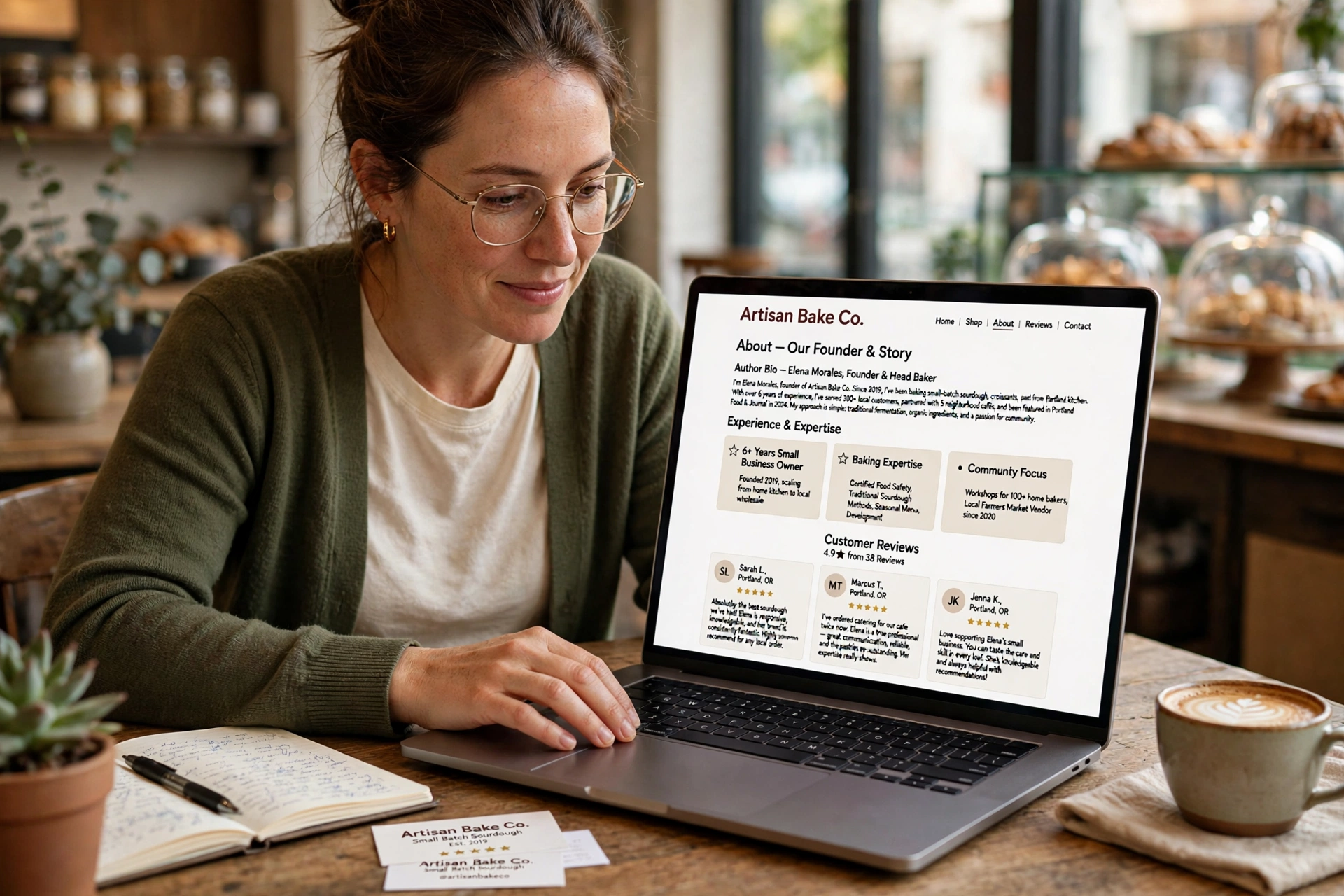
E-E-A-T stands for experience, expertise, authoritativeness and trust. It is how Google’s quality raters judge whether a page can be relied on. Trust matters most. A small business shows it with a named author on every page, real first-hand experience, sources for every figure, clear ownership and contact details, and genuine reviews from customers.
What does each letter of E-E-A-T mean?
E-E-A-T stands for experience, expertise, authoritativeness and trustworthiness, the qualities Google’s quality raters use to judge whether content is reliable, per sheen.af. The term comes from Google’s Search Quality Rater Guidelines, the handbook for the people who rate Google’s search results, per primal.co.th. Each letter asks a different question about a page, and the table below shows what each one means for a small business.
| Letter | What it means | What it looks like on a small business site |
|---|---|---|
| Experience | First-hand knowledge of the topic | A guide written by someone who has done the work, with their own photos and real results |
| Expertise | The knowledge or skill of the person who created the content | A named author with a role, background and other work a reader can check |
| Authoritativeness | How well known the creator or site is as a go-to source for the topic | Mentions, citations and links from respected sources in your industry |
| Trustworthiness | Whether the page is accurate, honest, safe and reliable | Clear ownership, contact details, cited sources, honest claims and secure payments |
Experience means first-hand knowledge of the topic, per human.marketing. A product review from someone who used the product, or a guide written by someone who has done the work, shows experience. Expertise means the knowledge or skill of the person who created the content, per human.marketing. For medical, legal or financial topics, that often means formal credentials. For most other topics, it means demonstrated depth. Authoritativeness means how well known the creator or site is as a go-to source for the topic, per human.marketing. Mentions, citations and links from respected sources in your industry build authority. Trustworthiness means whether the page is accurate, honest, safe and reliable, per human.marketing. Google calls trust the most important part of E-E-A-T, because a page that cannot be trusted has low quality no matter how much expertise it shows.
Google added E-A-T, for expertise, authoritativeness and trustworthiness, to its rater guidelines in 2014, then added a second E for Experience in December 2022, per human.marketing. The extra letter matters, because it means first-hand knowledge counts alongside formal expertise. A plumber who has fitted a hundred boilers can write a better guide to boilers than a writer who has only read about them, and Google’s raters are told to look for that difference.
How does Google actually use E-E-A-T?
The honest answer first: E-E-A-T itself is not a specific ranking factor, per Google’s page on creating helpful, reliable, people-first content, as reported by primal.co.th, human.marketing, nebula.design and kutola.co.uk. There is no E-E-A-T score you can look up, per primal.co.th. Google publishes no E-E-A-T score and no weight for any signal, per primal.co.th. So you cannot buy it, switch it on, or check it in a tool.
What Google does instead is use many signals that line up with E-E-A-T, per kutola.co.uk. Its systems aim to reward content that shows these qualities, per sheen.af. The raters who test Google’s results judge pages against the guidelines, and their judgements shape how Google’s systems are tuned. That is why the same qualities shape which sources AI search tools choose to cite, per kutola.co.uk.
The raters look in three places, in this order, per primal.co.th. First, what the site or writer says about itself: the About page and the writer’s profile come first. Second, what others say about it: reviews, news stories and other sources the site does not own. Third, what the page itself shows, including reviews and comments. A small business that gets those three right is doing most of the work.
E-E-A-T carries the most weight for Your Money or Your Life topics, known as YMYL: health, finances, safety and other subjects where a bad answer could hurt someone, per human.marketing. Topics that affect health, money or safety are held to a higher standard, per sheen.af. That does not mean other topics escape it. It means a health or finance page needs a qualified person behind it, while a guide to choosing a garden fence needs a real person who has built one.
The idea is not new. On 1 August 2018, Google rolled out a broad core algorithm update that the SEO industry nicknamed the Medic update, and it made E-E-A-T a priority, per human.marketing. The guidelines themselves are a serious document: the public handbook ran to 182 pages in its September 2025 edition, per kutola.co.uk. You do not need to read all of it. You need to understand the four letters and the practical steps below.
Who wrote this page?
The first step is also the simplest: say who wrote the page. Google’s helpful content guidance asks whether it is self-evident to your visitors who authored your content, whether pages carry a byline where one might be expected, and whether bylines lead to further information about the author, per kutola.co.uk. A page written by “Admin” asks the reader to take it on trust, per nebula.design. A page written by a named person, with a role and a short bio, does not.
Add an author name to every article and link it to a short bio page with the person’s role, background and areas of work, per sheen.af. That page should list the writer’s role, work history, education, credentials and public profiles a reader can check, per primal.co.th. Build author pages that include each author’s role, experience, credentials and links to their other work, per human.marketing. If a page was reviewed by a qualified person, say so on the page, with their name, role and qualifications, per primal.co.th.
Schema helps here too. Google’s Article markup guidelines recommend marking up every author shown on the page, using the Person type for individuals and adding a url or sameAs property that points to a page identifying them, such as an author profile, per kutola.co.uk. Read our guide to schema markup for small business WordPress beginners to see how that works on this site. It is a small job, and it connects the author on the page to the author in Google’s understanding of your site.
For pages that answer questions, put bylines on them. Question searches go mostly to articles, per primal.co.th, and those are the pages where a named author matters most. A service page can carry the business name instead, but a guide should carry a person’s name.
How do you show first-hand experience?
Show real work, real people and real details that only someone who did the work would know, per sheen.af. You do not need awards or press coverage to start. Use your own photos of your team, premises, products and completed projects instead of stock images, per sheen.af. Publish case studies that describe the problem, what you did and what was delivered, without exaggerating results, per sheen.af. Write from first-hand knowledge: the questions customers actually ask, the problems you see repeatedly, the trade-offs you recommend, per sheen.af.
Show first-hand work and say how the page was made, per primal.co.th. Use your own photos, results and steps from real jobs. In a review, say how many products you tested and what you found. If AI helped, say how. Google’s helpful content page puts this as three questions, who, how and why, per primal.co.th. It says “why” may matter most. The answer should be to help people.
The test is simple. Could this page have been written by someone who never did the work? If the answer is yes, it shows no experience. Add what only you can add, per human.marketing: original photos, product testing notes, before and after results, client examples, and your own data. Generic advice that could appear on any site shows none of it.
How do you back up your claims?
Give a source for every figure, per primal.co.th. Link to the original, such as a regulator, a platform’s own help pages or a study. Link statistics, quotes and factual claims to their original source, such as research papers, official documentation or government data, per kutola.co.uk. Cite your sources and link to them, especially for statistics, per nebula.design.
This matters for two reasons. First, a reader who can check a figure will trust the page more. Second, a rater who can see where a figure came from will judge the page more trustworthy. A page that states a number with no source is asking to be believed on faith, and Google’s raters are told not to do that.
If you are unsure about a fact, say so plainly, or leave it out. An honest gap is better than a confident guess. A page that admits what it does not know is more trustworthy than a page that invents an answer.
How do you make your business easy to verify?
Trust starts with knowing who stands behind a site, per kutola.co.uk. Say who runs the business. Put the company’s registered name, address, phone, email and contact details on an About or Contact page, per primal.co.th. Add the company registration number to the footer, per primal.co.th. If the site takes payments, make customer service easy to find, per primal.co.th.
Keep your About page specific: when the business started, who runs it, where it is based and what it does, per sheen.af. Make ownership obvious, per nebula.design. Your about page, company details, address and contact details all tell people and search engines who stands behind the site. If you take payments, make customer service easy to find and keep the payment pages secure.
Small businesses can demonstrate E-E-A-T through real author bios, first-hand photos and examples, clear contact details and honest reviews, per sheen.af. You do not need a large company to do this. A small local business with real experience, named people and accurate information can show strong E-E-A-T on the subjects it knows, per nebula.design. It is not about size. A small local charity with real experience, named people and accurate information can show strong E-E-A-T on the subjects it knows, per nebula.design, and the same applies to a small business.
How do you look after what others say about you?
What others say about you is the second place raters look, and it is the one you control least. That is exactly why it matters. Ask real customers for reviews on your Google Business Profile, per primal.co.th. Keep your profiles on industry sites complete, per primal.co.th. Earn mentions from trusted sources: partners, funders, local press and other businesses linking to your work, per nebula.design.
Reviews should be genuine, ideally on third-party platforms, with polite replies to negative ones, per sheen.af. A business that replies to a bad review calmly and fixes the problem looks more trustworthy than a business with only five star reviews and no replies at all. Do not buy reviews, and do not write your own. A fake review is easy to spot, and it damages trust far more than a missing review.
Citations and mentions help too. A listing in a trade directory, a mention in local news, or a link from a supplier’s stockist page all tell Google that your business is real and known. These are the same signals that help local search, and they help E-E-A-T for the same reason: they come from someone else, not from you.
What else does a trustworthy site need?
Keep the site secure and maintained, per nebula.design. That means HTTPS, up-to-date software, no broken links and no pages that are years out of date. A site with a security warning, a broken contact form or a blog that stopped in 2021 tells a visitor the business may have stopped too.
Review and date important pages, per nebula.design. For health or advice content, say who reviewed it and when, as NHS pages do with their “page last reviewed” dates. A date on a page tells a reader the advice is current, and it tells a rater the site is maintained.
Have a qualified person write or check YMYL pages, per primal.co.th. Show their name, role and qualifications on the page. If your business gives advice on money, health or safety, that step is not optional. It is the difference between a page a rater trusts and one they do not.
The table below brings the whole guide together as a checklist. Work through it for your most important pages first, then for the rest of the site.
| Check | What to look for | Done? |
|---|---|---|
| Named author | Every guide has a byline linked to an author page | |
| First-hand experience | Own photos, real examples, how the page was made | |
| Sources | Every figure linked to its original source | |
| Ownership | About page with who runs the business, where and since when | |
| Contact | Real address, phone and email, easy to find | |
| Reviews | Genuine reviews on third-party platforms, with replies | |
| Schema | Author and organisation marked up with Person and Organization types | |
| Maintenance | HTTPS, updates applied, no broken links, pages dated |
To see whether the work is paying off, learn how to measure SEO results in Google Search Console. Look at clicks and click through rate for the pages you improved, and compare the weeks before and after. A rise in clicks, with position roughly the same, is a good sign that the richer, more trustworthy listing is winning more clicks.
Frequently asked questions
What does E-E-A-T stand for?
Experience, Expertise, Authoritativeness and Trustworthiness. It is the framework Google uses to describe high-quality content in its Search Quality Rater Guidelines, per human.marketing.
Is E-E-A-T a ranking factor?
Not directly. Google says E-E-A-T itself is not a specific ranking factor, but its systems use many signals that line up with it, per kutola.co.uk. There is no E-E-A-T score to check.
Does E-E-A-T apply to small websites?
Yes. It is not about size. A small local business with real experience, named people and accurate information can show strong E-E-A-T on the subjects it knows, per nebula.design.
What matters most in E-E-A-T?
Trust. Google says the other three contribute to it, per nebula.design. A page that cannot be trusted has low quality no matter how much expertise it shows, per human.marketing.
How do I show experience on my site?
Use your own photos, case studies and real results. Say how many products you tested, what you did, and what happened. Write from first-hand knowledge, not from what you read somewhere else.
What should my About page say?
When the business started, who runs it, where it is based, what it does, and how to contact it. Keep it specific, per sheen.af. A vague About page shows nothing a rater can trust.
Conclusion
E-E-A-T is not a trick to add to a page. It is the sum of what your pages show and what others say about you, per kutola.co.uk. You cannot add it with a plugin. You show it through the content, the people behind it, and the reputation your business has elsewhere on the web, per sheen.af. Start with the basics: a named author on every guide, real first-hand experience, a source for every figure, clear ownership and contact details, and genuine reviews. Then keep the site secure, maintained and up to date. A small business that does those things, page by page, will look trustworthy to readers, to raters and to Google, and that trust is what turns a visit into an enquiry.