
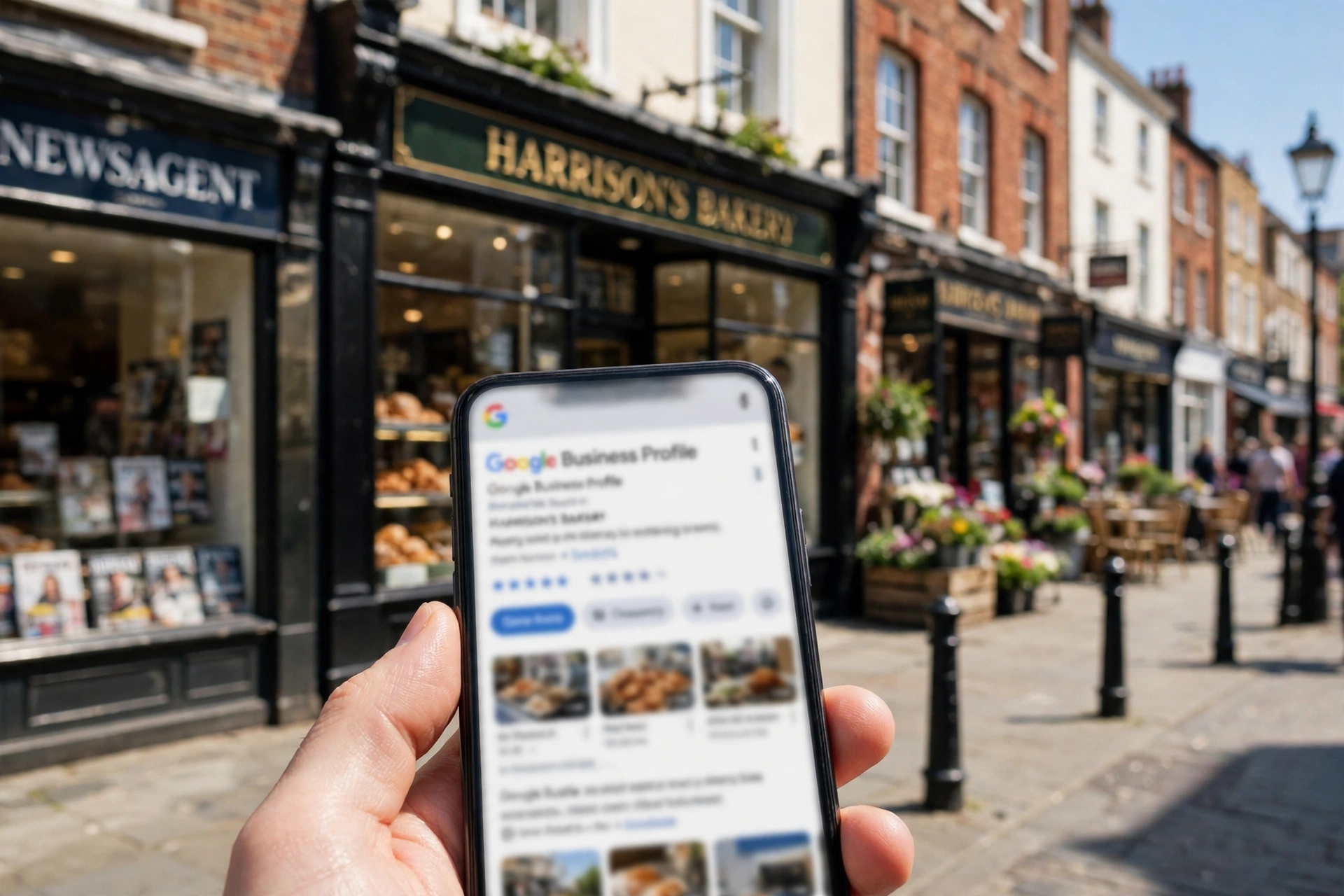
Local SEO is how a small business shows up when someone nearby searches for what it sells. A search for “plumber near me” or “best cafe in York” is decided by local signals, not by who has the biggest website. That is good news for a small business, because the signals are mostly things you can control yourself.
This checklist works through those signals in order. Start at the top and tick them off one by one.
Direct answer
Local SEO for a small business in the UK means making it easy for Google to show your business to nearby searchers. Claim and complete your Google Business Profile, keep your name, address and phone number identical everywhere, list on UK directories such as Yell and Thomson Local, add it to Bing Places and Apple Maps, and collect honest reviews.
What is local SEO?
Local SEO is search engine optimisation focused on a place. When someone searches with a location, or with words like “near me”, Google shows a map pack of local businesses above the normal results. The businesses in that pack are chosen by three things: relevance, distance and prominence.
Relevance means your business matches the search. Distance means how close you are to the searcher. Prominence means how well known and trusted your business looks online. You cannot change your location, but you can improve relevance and prominence a great deal.
How do you set up a Google Business Profile?
Your Google Business Profile is the single most important local SEO asset you have. It is free, and it controls what appears in the map pack and in Google Maps.
Claim the profile at Google Business Profile and verify it. Verification usually comes by postcard, phone or email, depending on the business type. Then complete every field. Add the exact business name, the full address, the phone number, the website, the opening hours and the business category. Choose the most specific category available, such as “plumber” rather than “home services”.
Add photos of the shop front, the team and the work. Add a short description in plain words. Then keep it alive. Post an update once a month, answer questions that appear on the profile, and reply to every review. A profile that is complete and active beats a profile that was claimed and forgotten.
Which UK directories should you list on?
A citation is any mention of your business name, address and phone number on another website. Google uses citations to check that your business is real and to confirm where it is. The details must match exactly everywhere. If your address is “12 High Street” on Google and “12 High St” on Yell, that mismatch weakens the signal.
Start with the big ones, then add the UK specific directories. All of the listings below are free to create.
| Directory | Why it matters | What to check |
|---|---|---|
| Google Business Profile | Controls the map pack and Google Maps | Every field complete, photos added, hours correct |
| Bing Places | Feeds Bing and its maps, used by many Windows users | Same name, address and phone as Google |
| Apple Maps | Feeds iPhone maps and Siri searches | Listed through Apple Business Connect, details matching |
| Yell | The main UK business directory, still widely used | Free listing claimed, categories correct |
| Thomson Local | UK directory with strong local search presence | Free listing claimed, details matching |
| Yelp | Reviews and local search, strong in larger UK cities | Claimed, photos added, reviews answered |
| Scoot | UK local directory, free basic listing | Details matching your Google profile |
How do reviews help local SEO?
Reviews affect both parts of local SEO. They influence whether Google trusts your business, and they influence whether a searcher clicks on it. A business with 40 honest reviews at 4.6 stars will win clicks over a business with 2 reviews at 5 stars.
Ask every happy customer. A short message after the job is done, with a direct link to your Google review page, is enough. Make it easy and most people will not bother, so ask at the moment they are happiest, not a week later.
Reply to every review, good or bad. Thank the good ones by name. For a bad review, apologise briefly, explain what happened without arguing, and invite the customer to contact you directly. Future customers read your replies as much as they read the reviews.
What should your website say about your location?
Your own website must back up what the directories say. Put the full business name, address and phone number in the footer of every page, exactly as it appears on Google. Add a contact page with the address, a map, opening hours and directions from a well known local landmark.
Use the town or city name naturally in your content. A page titled “Bathroom Fitting in Leeds” is clearer than a page titled “Our Services”. Add a short line about the areas you serve, such as “We cover Leeds, Bradford and Harrogate”. Do not list fifty towns you never visit. Google and customers both notice when a list is invented.
How do you keep local SEO working over time?
| Monthly check | What to do |
|---|---|
| Google Business Profile | Check hours, add one photo, post one update, reply to new reviews |
| Reviews | Ask three recent customers, reply to all new reviews |
| Citations | Check one directory a month for matching details |
| Website | Add one local page or update one existing page |
| Search Console | Check which local queries bring visits and which pages rank |
When should you hire an SEO expert?
Most of this checklist can be done by the business owner. If you have done it all and still do not appear in the map pack, or if you run several locations, outside help can be worth it. An SEO expert can check technical issues, study competitors and build a longer term plan.
Read our guide to what an SEO expert does to understand what that help should include and what questions to ask before you hire anyone.
FAQ
What is local SEO?
Local SEO is the work of helping a business appear in Google’s local results, the map pack and Google Maps, when nearby people search for what it sells.
Is a Google Business Profile free?
Yes. Claiming and managing a Google Business Profile costs nothing. Verification is usually by postcard, phone or email.
How many directories should I list my business on?
Start with Google Business Profile, Bing Places, Apple Maps, Yell and Thomson Local. Add more only if they are relevant to your area or trade.
Do reviews really affect rankings?
Yes. Reviews affect both how much Google trusts your business and how likely searchers are to click on it. Honest reviews, replied to promptly, are one of the strongest local signals.
How long does local SEO take to work?
A complete Google Business Profile can show results within weeks. Citations and reviews build over months. Expect steady progress rather than an overnight change.
Conclusion
Local SEO rewards businesses that are consistent and active. Claim your Google Business Profile and complete it properly. Keep your name, address and phone number identical on Yell, Thomson Local, Bing Places and Apple Maps. Collect honest reviews and reply to them. Put real local detail on your website. None of this needs a big budget, and it fits neatly into a wider digital strategy for small business. Work through the checklist, repeat it monthly, and your business will be the one nearby searchers find first.