
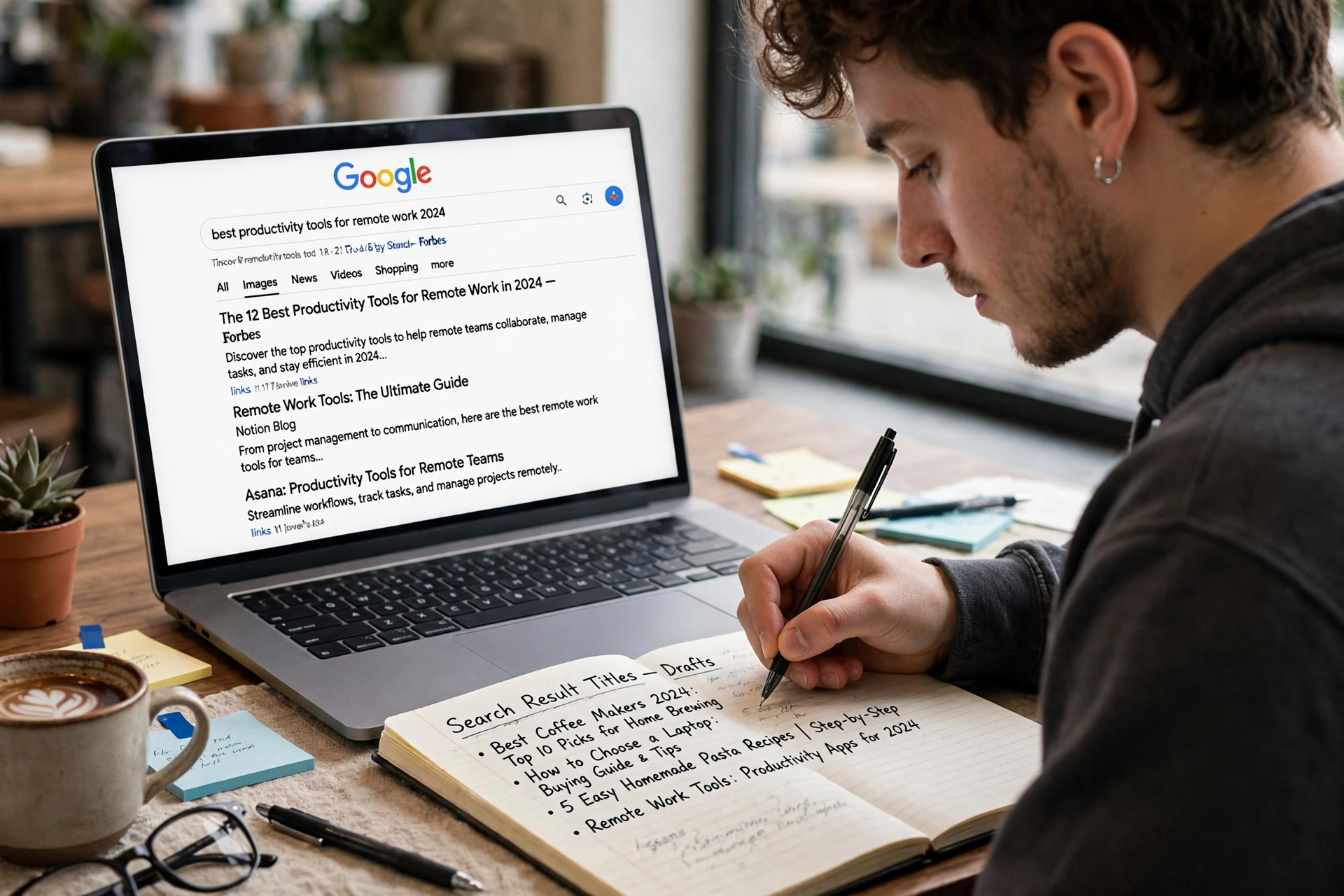
A page can rank on the first page of Google and still get almost no clicks. The reason is usually the title. The title is the blue link people see in the search results, and it does the persuading. A dull title gets skipped. A clear title with a real promise gets clicked.
Writing good titles is the cheapest traffic win in SEO. You do not need new content or new links. You need to rewrite the titles on the pages you already have, one at a time, and check whether clicks go up.
Direct answer
To write SEO titles that get clicks, put your main keyword near the front, keep the title to about 50 to 60 characters, and make one specific promise about what the reader will get. Match the search intent behind the query, be honest about what the page delivers, and give every page a unique title.
What is an SEO title and how is it different from a heading?
An SEO title, also called a title tag, is the HTML title of a page. It shows up as the blue clickable headline in Google, as the text on the browser tab, and often as the default text when someone shares your page. It is not the big heading on the page itself. That is the H1.
Google calls the clickable headline a title link, and the antorseo guide notes that Google says the title link is often the primary piece of information people use to decide which result to click on. That is why the title matters so much. It is the first and sometimes the only thing a searcher reads before choosing.
Your title does not always appear exactly as you wrote it. The seothemes guide reports, citing Google’s own figures, that Google shows your own title tag about 87 percent of the time and rewrites the rest. Google rewrites titles that look vague, stuffed with keywords, or out of date. A clear title gets rewritten less often, so writing it well pays twice.
How long should an SEO title be?
Google generally displays the first 50 to 60 characters of a title tag before cutting it off with an ellipsis, according to the searchblueprint and antorseo guides. Aim for that range. If your title is longer, the important words at the end may never be seen.
Google measures width rather than characters, so a title full of wide capital letters can be cut at 48 characters while a title of narrow lowercase letters can survive past 65. Treat 50 to 60 as a target zone, and put the important words first so that truncation costs you nothing.
Where should the keyword go?
Put your main keyword as close to the front as natural language allows. Searchers scan results from left to right and stop at the match. Google also gives slightly more weight to early words when matching a title to a query.
Use the keyword once. Do not repeat it twice in one title, and trim stop words such as “and”, “the” and “of” where the title still reads naturally without them. One keyword, one promise, and a natural reading flow is the formula that holds up.
What makes a title worth clicking?
A clickable title makes a clear promise and matches what the searcher actually typed. It answers one question: what will I get if I click this? Vague titles get skipped, and specific ones get clicked.
Three things separate a clickable title from a forgettable one. First, it names the outcome, such as a fixed price, a checklist, or a step by step guide. Second, it matches the intent behind the query, so a how to search gets a how to title, not a sales pitch. Third, it is honest. A title that over promises gets clicked once and then ignored, and Google also tracks people who click back to the results quickly, which hurts your rankings over time.
Which title formulas work?
Formulas are not magic, but they beat a blank field. Each one answers the searcher’s unspoken question: why this result, and why now?
| Formula | Example | When to use it |
|---|---|---|
| How to plus outcome | How to Fix a Leaking Tap in 30 Minutes | Teaching a skill or solving a problem |
| Number plus benefit | 7 Roof Repairs You Can Skip in 2026 | A list with a clear payoff |
| Question the searcher asks | How Much Does a Boiler Service Cost? | The query is already a question |
| Comparison | Gas vs Electric Heating: Which Costs Less? | The searcher is choosing between two options |
| Specific detail | Plumber in Leeds, Same Day Callouts, Fixed Prices | Local services where detail builds trust |
Use numbers only when the post really is a list, and use a year only when the content is year specific. A stale year is one of the reasons Google rewrites titles, and a number that does not match the content breaks trust the moment the reader arrives.
What does a good title look like in practice?
The fastest way to learn is to rewrite weak titles into strong ones. Compare the pairs below and notice the pattern: delete the brand from the front, delete the adjectives, and replace them with one concrete fact, such as a price, a response time, or a number.
| Weak title | Stronger title | Why it works |
|---|---|---|
| Welcome to Our Website | Boiler Service Leeds, Fixed Price, Book Online | Names the service, the place and the action |
| SEO Tips for Beginners | How to Write SEO Titles That Get Clicks | Names the exact outcome and skill |
| Our Services | Emergency Plumber in Manchester, 24 Hour Callout | Specific, local, and time sensitive |
| Blog | Local SEO Checklist for Small Business UK | Says exactly what the page contains |
| Best Quality Products at Great Prices | Handmade Leather Wallet, Free UK Delivery | One product, one fact, no empty claims |
Every stronger title follows the same rules. Keyword near the front, about 50 to 60 characters, one clear promise, and nothing the page does not deliver.
What mistakes make Google rewrite your title?
The most common mistake is duplicate titles. If ten product pages all share one title, Google cannot tell them apart, and searchers comparing tabs cannot either. Give every page its own title.
The next mistake is keyword stuffing. A title that reads like a list of keywords looks untrustworthy and earns fewer clicks, and Google is likely to replace it with something from the page. One keyword is enough.
Clickbait is another mistake. A title that promises more than the page delivers gets the click once, but the visitor leaves fast and does not click your result a second time. Google notices fast returns to the search results, and it counts against the page.
Finally, do not put your brand name first. Searchers do not care about your brand until they know what you do. Put the keyword and the benefit first, and the brand at the end if there is room.
How do you check whether your new titles work?
Do not judge a title by how it looks. Judge it by the clicks it brings. Open Google Search Console, go to the Performance report, and filter to the page you changed. Compare the click through rate for the four weeks before the change with the four weeks after. Allow two to three weeks after a title change for Google to recrawl the page and for the data to settle.
Look for pages that already rank on page one but have a low click through rate. Those are your best candidates. A page ranking fifth with a great title routinely out clicks a page ranking third with a dull one, because the title does the persuading. Fix the titles on those pages first, and work through the rest a few at a time.
Once the titles are working, make sure the pages they lead to are connected. Read our guide to internal linking for SEO to see how links between your pages help Google understand your site, and use our local SEO checklist to check the titles on the pages that bring in local customers.
FAQ
How long should an SEO title be?
About 50 to 60 characters. Google displays roughly the first 50 to 60 characters before truncating the rest, so put the keyword and the main benefit first.
What is the difference between an SEO title and an H1?
The SEO title is the blue link in Google search results and the text on the browser tab. The H1 is the main heading shown on the page itself. They can be similar, but they do different jobs.
Should the keyword go first in the title?
Yes, as close to the front as natural language allows. Searchers scan from left to right, and Google gives slightly more weight to early words.
Why does Google rewrite my title?
Usually because the title is vague, stuffed with keywords, duplicated on other pages, or out of date. Clear, specific, unique titles get rewritten far less often.
How do I know if a new title is working?
Check the click through rate in Google Search Console. Compare the four weeks before the change with the four weeks after, and allow two to three weeks for Google to recrawl the page.
Conclusion
Good SEO titles are simple: one keyword near the front, about 50 to 60 characters, one specific promise, and honesty about what the page delivers. Match the search intent, use numbers and years only when they are true, give every page a unique title, and put the brand last. Then check the results in Search Console and rewrite the titles that are not earning their clicks. It is the cheapest traffic win on your site, and it is available on every page you already rank for.