
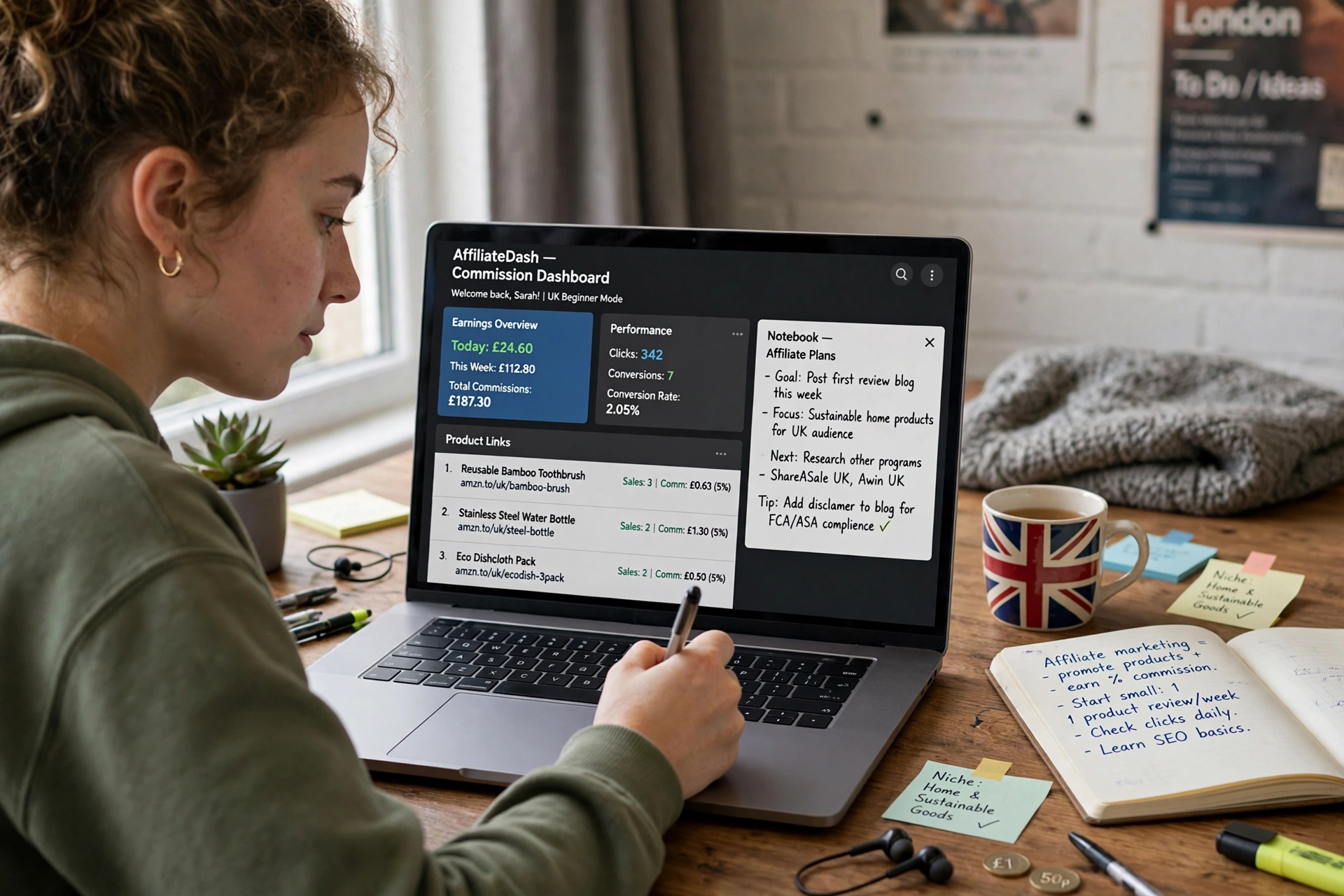
Affiliate marketing sounds like easy money. You write about a product, someone buys through your link, and you earn a commission. The idea is simple, and the idea is real, but the easy money part is not. Most beginners earn little in their first months, and many give up before the work pays off. The ones who succeed treat it like a small business: they pick one niche, recommend products they have actually used, and build trust with readers over time.
This guide is for a beginner in the UK. It explains how affiliate marketing works, which networks to join, what content earns, the disclosure rules enforced by the ASA, the tax you need to know, and what earnings are realistic. It is honest about the time it takes and the mistakes that kill beginner sites. If you want a quick income, this is not it. If you want a slow, real income from recommendations you stand behind, read on.
Direct answer
Affiliate marketing means recommending a product with a tracked link and earning a commission when someone buys through it. A UK beginner should pick one niche, join Awin or Amazon Associates, write honest reviews of products they have used, disclose the link clearly at the top, and declare income above the £1,000 trading allowance.
What is affiliate marketing?
Affiliate marketing is performance based marketing. You recommend a product, a reader clicks your tracked link, and if they buy, you earn a commission. You do not make the product, hold stock, handle delivery or deal with returns. The merchant does that. Your job is the recommendation, and the commission is your payment for it.
The key word is performance. You are not paid for showing an advert or for getting clicks. You are paid when a purchase happens through your link. That is why merchants like it: they only pay when they make a sale. It is also why beginners find it slow at first. A recommendation only earns when a reader trusts it enough to buy, and trust takes time to build.
Affiliate marketing is not the same as display advertising, and it is not the same as selling your own product. Display adverts pay for views. Your own product gives you the full price but also the full work. Affiliate marketing sits between the two: less work than your own product, less money per sale, and no payment unless the reader buys.
How does the money move?
The money moves through a tracked link. When you join a programme, you get a special link for each product. When a reader clicks it, a small file called a cookie is stored on their device. If they buy within the cookie period, the sale is credited to you, and you earn a percentage of the price.
The cookie period matters. Amazon Associates pays 1 to 12 percent commission depending on category, with a 24 hour cookie, per snagly.co.uk. That means the reader must buy within a day of clicking, or the sale is not credited to you. Awin merchants often offer 30 to 90 day cookies, per snagly.co.uk, which gives the reader weeks to decide, and gives you a much better chance of earning from the click.
The commission rate also varies. A 1 percent commission on a £20 product is 20 pence, while a 10 percent commission on a £200 product is £20. That difference is why the niche matters so much. Recommending cheap products to a large audience can work, but recommending expensive products to a small, serious audience often earns more, with fewer readers.
Which type of programme should a beginner start with?
There are three main types of affiliate programme. A beginner should start with pay per sale, which is the simplest and the most common. You earn a percentage when a reader buys. Pay per lead pays you when a reader signs up, fills in a form or books a call. Pay per click pays you for each click, but it is rare now and pays very little.
| Programme type | How you earn | Best for a beginner |
|---|---|---|
| Pay per sale | A percentage of the purchase price | Most beginners, the simplest starting point |
| Pay per lead | A fixed fee when a reader signs up or books | Services, finance and insurance niches |
| Pay per click | A small fee for each click | Rare, and usually too little to be worth it |
Pay per sale is the right starting point because it matches the reader’s intent. A reader who clicks a link to a product they want is close to buying, and your job is to help them decide. Pay per lead suits niches where the product is a service, such as insurance or a booking, and the merchant values the enquiry itself. Pay per click is not worth chasing for a beginner, because the payment per click is tiny and the traffic needed is huge.
How do you pick a niche?
Pick a niche you know, or one you are willing to learn properly. A niche is a small corner of a market, not a whole industry. Home coffee is a niche. Kitchen gadgets is not, because it is too broad. Walking boots for wide feet is a niche. Footwear is not.
The test is simple. Can you name ten products in the niche, and can you say something useful about each one? If you can, you know the niche well enough to start. If you cannot, pick a smaller corner or spend a month learning before you publish anything. Readers can tell when a writer has never used a product, and they will not trust a recommendation from someone who clearly has not.
Check that the niche has products worth recommending. A niche with no products over £30 will need huge traffic to earn anything. A niche with products between £50 and £300, where buyers research before they buy, is a good place to start. That is the kind of purchase where a reader reads a guide, compares options and clicks a link, which is exactly the behaviour that earns commission.
Which UK networks are worth joining?
A network sits between you and the merchants. It gives you one place to find programmes, one dashboard to track clicks and sales, and one payment each month. In the UK, two networks matter most for a beginner, with two more worth knowing.
| Network | What it offers | Notes for a beginner |
|---|---|---|
| Awin | The UK’s largest affiliate network, with brands including John Lewis, Boots, Etsy, Currys, M&S and TUI | A £5 deposit to join, refunded on first payment |
| Amazon Associates | A huge range of products in almost every category | Pays 1 to 12 percent, with a 24 hour cookie |
| CJ Affiliate | Large brands, mainly in retail, travel and finance | A bigger network, better once you have traffic |
| ShareASale | Many smaller merchants and niche brands | Useful for niches Amazon does not serve well |
Awin is the UK’s largest affiliate network, hosting brands including John Lewis, Boots, Etsy, Currys, M&S and TUI, with a £5 deposit to join refunded on first payment, per snagly.co.uk. That makes it the first network to join for a UK beginner. Amazon Associates is the second, because it covers almost every product a reader might want, even though the cookie is short and the commission varies by category.
Join one network first, learn how it works, and add the second when you have ten pieces of content published. Joining five networks on day one spreads your effort and fills your dashboard with programmes you will never use. Before you join, it helps to know how to do keyword research for a small business website, so you can check that real people search for the products you plan to recommend, and see which questions they ask before they buy.
What content actually earns?
Content earns when it helps a reader decide. The best affiliate content is a genuine recommendation for a product you have used, written for a reader who is close to buying. That means guides that compare two or three options, reviews that say what is good and what is not, and how to choose articles that explain the differences that matter.
A realistic affiliate article converts 1 to 3 percent of readers into clicks that lead to a purchase, for genuine buying intent content, per earningmoneyonline.co.uk. That means 97 to 99 readers out of 100 will not buy, and that is normal. The article earns because a small share of a steady flow of readers buys, month after month, and the article stays on your site earning for years.
Write about products you have used. A review of a product you have never touched will sound like every other review on the internet, and readers will not trust it. Say what you liked, say what you did not like, and say who the product suits and who should skip it. An honest review that says a product is not right for everyone earns more trust, and more sales, than a review that praises everything.
Short posts do not earn. A 300 word post that says a product is great will not rank and will not convince anyone. A 1,000 word guide that compares options, answers questions and shows the differences will rank, will be read, and will earn. The same skill applies to product pages: learn how ecommerce product page SEO works, because a good recommendation needs the same clear structure, honest details and useful answers that make a shop page sell.
What are the disclosure rules?
Disclosure is legally required under UK CAP Code rules enforced by the ASA. You must clearly state at the top of any content containing affiliate links that you may earn a commission, per snagly.co.uk. That is not a suggestion. It is a rule, and breaking it can get your content reported and your account closed.
The disclosure must be upfront and prominent, not buried. Put it at the top of the article, before the first link, in plain words. A line such as “This article contains affiliate links. If you buy through a link, I may earn a commission at no extra cost to you.” is clear enough. Do not hide the disclosure at the bottom of the page, in small text, or behind a link that says “disclosure policy”. A reader should see it before they click anything.
The Competition and Markets Authority, the CMA, has the same expectation. It has taken action against businesses that hid paid endorsements, and it expects affiliate links to be clearly labelled. The rule is simple: if you earn from a link, say so, at the top, in plain words.
You must always disclose affiliate links, and any forms collecting personal data must be GDPR compliant, per crunch.co.uk. If your site has a newsletter signup or a contact form, check that it asks for consent properly and says what the data will be used for. Disclosure and GDPR are both about honesty with your readers, and both are worth getting right from the start.
What tax do you need to know?
Affiliate income is taxable in the UK and above the £1,000 threshold you must submit a Self Assessment and declare all income, per crunch.co.uk. The good news is the £1,000 trading allowance means your first £1,000 of affiliate income per tax year is tax free, per snagly.co.uk. That allowance covers your first £1,000 of trading income in a tax year, and you do not need to tell HMRC about income below it, as long as your total trading income stays under that amount.
Once your affiliate income goes above £1,000 in a tax year, you must register for Self Assessment and declare all of it, not just the amount above £1,000. Keep records from day one: every payment, every month, from every network. A simple spreadsheet with the date, the network, the amount and the month is enough. Keep it up to date, because reconstructing a year of payments from emails is a miserable job.
If you are not sure whether you need to register, check the HMRC guidance on the trading allowance, or speak to an accountant. This guide is not tax advice, and the rules can change. What matters is that you know the allowance exists, you keep records from the start, and you declare income once you pass the threshold.
What earnings are realistic?
Beginners typically earn £0 to £200 a month in the first 6 months, and after 12 to 18 months of consistent work £500 to £3,000 a month is achievable in most niches, per snagly.co.uk. Those figures are a guide, not a promise. Your earnings will depend on your niche, your traffic, the price of the products and how much content you publish.
The UK market is large. UK brands spent £1.8bn on affiliate and partner marketing in 2025 and it generated £20.7bn in revenue, a 15 to 1 return, per earningmoneyonline.co.uk. The UK is the third largest affiliate market in the world after the US and China, and the biggest in Europe, accounting for about 15 percent of global affiliate activity, per earningmoneyonline.co.uk. UK ecommerce sales are predicted to reach around £141.95 billion by 2029, per crunch.co.uk. The market is there. The question is whether you can build the content and the trust to earn a share of it.
Expect the first six months to be slow. You will publish guides, and few people will read them, because new sites take time to rank. Expect months 6 to 12 to be the turning point, when older guides start to rank and a few earn each month. Expect the second year to be the one where the income becomes real, if you kept publishing through the quiet first year. Most beginners quit in month three, before the work has had time to pay off. The ones who keep going are the ones who earn.
Which five mistakes kill beginner sites?
First, promoting products you have never used. Readers can tell, and they will not buy. Second, writing only short posts that say a product is great, with no comparison, no detail and no honest downside. Third, hiding the disclosure at the bottom of the page, which breaks the ASA rules and loses trust when a reader finds it. Fourth, joining ten networks and promoting fifty products before you have ten good articles. Fifth, quitting after three months because the income is small. Every one of these mistakes is easy to make and easy to avoid, once you know to look for them.
Which myths cost beginners money?
Three myths cost beginners the most. The first myth is that affiliate marketing is passive income. It is not. The income becomes passive after the content is written and ranking, but writing the content is real work, and keeping it updated is real work too. The second myth is that you need a large audience. You do not. A small audience of buyers earns more than a large audience of browsers. A guide that brings 100 readers a month, of whom 2 buy a £100 product at 5 percent commission, earns £10 a month from one page. Ten such pages earn £100 a month. The third myth is that the best products to promote are the ones with the highest commission. They are not. The best products are the ones your readers actually need, and the ones you can recommend honestly. A high commission on a product nobody wants earns nothing.
Frequently asked questions
What is affiliate marketing?
It is recommending a product with a tracked link and earning a commission when someone buys through it. You do not make, stock or deliver the product.
Which network should a UK beginner join first?
Awin is the UK’s largest affiliate network, hosting brands including John Lewis, Boots, Etsy, Currys, M&S and TUI, with a £5 deposit to join refunded on first payment, per snagly.co.uk. Amazon Associates is the second network to join, for its huge product range.
Do I have to disclose affiliate links in the UK?
Yes. Disclosure is legally required under UK CAP Code rules enforced by the ASA, and you must clearly state at the top of any content containing affiliate links that you may earn a commission, per snagly.co.uk.
How much tax do I pay on affiliate income?
The £1,000 trading allowance means your first £1,000 of affiliate income per tax year is tax free, per snagly.co.uk. Above that threshold you must submit a Self Assessment and declare all income, per crunch.co.uk.
How much can a beginner earn from affiliate marketing?
Beginners typically earn £0 to £200 a month in the first 6 months, and after 12 to 18 months of consistent work £500 to £3,000 a month is achievable in most niches, per snagly.co.uk.
Conclusion
Affiliate marketing for a UK beginner is a slow business, not a quick one. Pick one niche you know, join Awin and Amazon Associates, write honest guides about products you have used, disclose your links at the top, keep records from day one, and declare income above the £1,000 trading allowance. Publish steadily for a year, and the guides will start to earn. The market is large, the rules are clear, and the work is honest. That is a fair deal, and it is worth doing properly.