
Most small business owners have heard that they should do content marketing, and most of them have tried it once and stopped. They wrote three blog posts in a busy week, heard nothing back, and decided it does not work. The problem is not the idea. The problem is the way it was tried. Three posts in one week, then silence for six months, is not content marketing. It is a burst of effort with no system behind it.
Content marketing works slowly, then all at once. A guide you publish today can still bring enquiries a year from now, because it sits on your website and answers the same question for every new visitor. An advert stops the day you stop paying. A useful article keeps working. That is why small businesses with a steady habit of publishing do better over time than businesses that rely on adverts alone.
This guide explains content marketing for a complete beginner. It covers what it is, why it works for a small business, how to start with the questions your customers already ask, which formats to choose, how much time it really takes, and a realistic plan for your first three months.
Direct answer
Content marketing is publishing useful material that answers your customers’ questions, such as guides, videos and short posts, so people find you, trust you and buy from you. For a small business it means one useful piece a month, reused across social media and email, and kept going for at least six months before you judge it.
What is content marketing?
Content marketing means publishing useful material that helps your customers, instead of only telling them to buy. A guide, a short video, a checklist or a plain answer to a common question all count as content. The material is free to read, it solves a real problem, and it shows that you know your subject. The sale comes later, when the reader trusts you enough to get in touch.
That is the difference between content marketing and advertising. An advert interrupts people and asks for a sale now. Content helps people first and earns the sale over time. A plumber who writes a clear guide to bleeding a radiator is not selling a visit in that article. He is proving that he knows heating systems, so when the reader needs a plumber, his name is the one they remember.
Content marketing is not the same as having a blog. A blog is one place to publish content. Social media posts, short videos, emails and downloadable checklists are content too. What matters is not the format. What matters is that every piece answers a real question from a real customer, in plain words, and that you publish it on a schedule you can keep.
Why does content marketing work for a small business?
Content marketing works for a small business for three reasons: search, trust and time. Search engines send people to pages that answer their questions. A useful guide can rank for the exact question a buyer types into Google, and that visitor arrives already interested. Trust grows because the reader has seen you solve a problem before they have paid you anything. Time works in your favour because content stays on your site and keeps bringing visitors, while an advert stops the moment you stop paying.
The numbers back this up. Small businesses with active blogs generate 126 percent more leads than those without, per HubSpot, as reported by outcomedigitalmarketing.com. According to BrightEdge research, organic search drives 53 percent of all website traffic, per outcomedigitalmarketing.com. Research from Demand Metric found that content marketing generates 3 times more leads than traditional outbound marketing while costing 62 percent less, per outcomedigitalmarketing.com and sideshift.app. And 70 percent of consumers prefer learning about a company through articles rather than ads, per the Content Marketing Institute, as reported by omniovus.com.
Those figures describe averages, not promises. Your results will depend on your niche, your consistency and the quality of what you publish. But the direction is clear. People search for answers before they buy, and the businesses that publish the answers are the ones they find. According to SEMrush’s 2025 State of Content Marketing report, 97 percent of marketers surveyed say content marketing is an important part of their overall strategy, per outcomedigitalmarketing.com. That does not mean you need a large budget. It means the habit matters, and a small business can build it one piece at a time.
There is also a practical benefit. Every piece of content you publish becomes material you can reuse. One guide can become three social posts, one email and a short video. That is how a small business with one owner and no marketing team can keep a steady presence without working every evening.
How do you start with real customer questions?
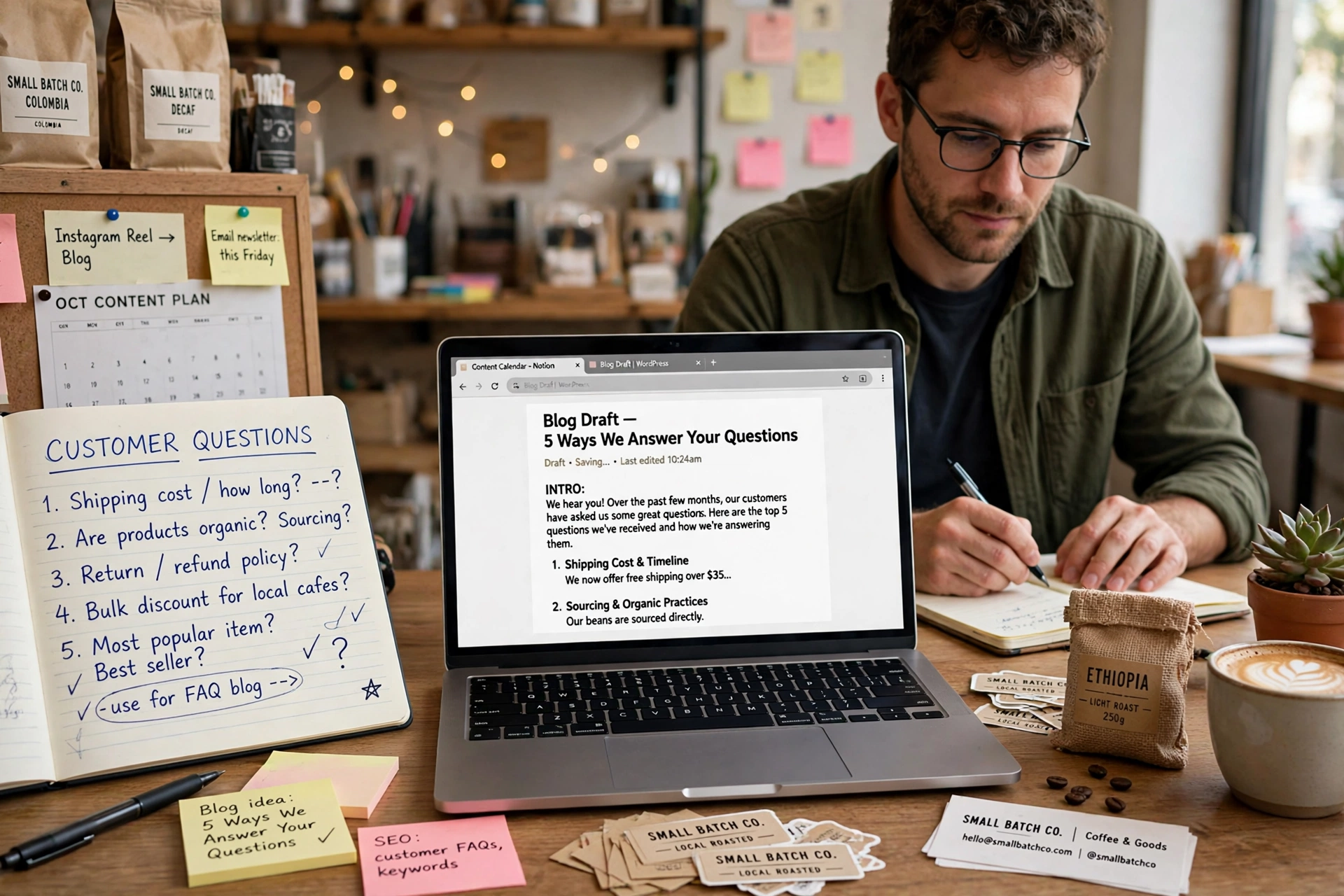
The best place to start is not a keyword tool. It is your own inbox, your phone and your shop counter. Every question a customer has asked you more than once is a topic for a piece of content. If three people asked this month whether your product suits sensitive skin, that is an article. If five people asked how long delivery takes to their town, that is a short post. Your customers are telling you what to write. You only have to listen.
This approach is sometimes called They Ask, You Answer. It means you write about the questions people actually ask, in the words they actually use, instead of guessing at clever topics. It has two benefits. First, the content is useful, because it answers a real question. Second, it matches the words buyers type into search, because customers search using the same words they use when they ask you.
Start by writing a list of 20 questions. Look through your emails, your messages, your reviews and your memory of the last month of conversations. Write each question down exactly as the customer asked it. Then sort the list. Put the questions that come up most often at the top. Put the questions that sit closest to a sale next. A question about price, safety, size or delivery is closer to a sale than a general question about your trade. Your first ten pieces of content should come from the top of that list.
If you run out of questions, ask your customers directly. Put a question on your social media page, add a line to your next email, or ask the next five customers what they wish they had known before they bought. You will have new topics within a day. Before you plan each piece, it helps to know how to do keyword research for a small business website, so you can check that real people search for the question and see which words they use.
Which formats should you start with?
Beginners often think content marketing means writing long blog posts every week. It does not. A blog post is one format, and it is a good one, but it is not the only one, and it is not always the best place to start. Choose the format that fits the question, your skills and the time you have.
| Format | Effort per piece | Best for | Start with it when |
|---|---|---|---|
| Blog post or guide | 2 to 4 hours | Answering questions in depth and ranking on Google | The question needs more than a short answer |
| Short video | 1 to 2 hours | Showing a process, a product or a place | The answer is easier to show than to describe |
| Social media post | 15 to 30 minutes | Reaching people who already follow you | You want a quick tip or a short update |
| 1 to 2 hours | Staying in touch with past customers | You have a list, even a small one | |
| Checklist or template | 2 to 3 hours | Giving readers something to keep and use | The advice has clear steps to follow |
A blog post suits questions that need a full answer, such as how to choose a product or how a service works. A short video suits anything you can show, such as fitting a part, preparing a product or walking through a room. A social post suits a quick tip, a photo or a short answer. An email suits news, offers and reminders for people who already know you.
Do not try all five at once. Pick two. For most small businesses, a blog post and a short social post work well together, because one piece of writing can become several social posts. Write the guide first, then pull three short tips from it for social media during the same week. That is one piece of work used twice, and it is how a busy owner keeps going.
Your titles matter as much as the content. A clear title that states the question and the benefit will win more clicks than a clever title that hides the subject. Learn how to write SEO titles that get clicks before you publish your first pieces, because a good title is the difference between a guide that is read and a guide that sits unseen.
How much time does content marketing take?
Less than most owners fear, and more than zero. The minimal viable effort is 2 to 4 hours per month, one blog post per month, per presencekit.co. That is enough to build a small library of useful pages over a year. It will not bring fast results, but it is a pace almost any owner can keep, and a pace you keep beats a pace you abandon.
A steadier rhythm is one anchor piece per month, two or three social posts a week from it, and one email a month, per tryscafflow.com. That rhythm takes about an hour a week once you are used to it. The anchor piece is the main guide. The social posts are short tips, photos or quotes taken from it. The email is a short note to your list pointing at the guide.
Do not judge the results in the first month. A blog post published today might take 3 to 6 months to rank on Google, per outcomedigitalmarketing.com, and content marketing typically takes 6 to 12 months to produce significant, measurable results, per omniovus.com. That is normal. The early months feel quiet, because each piece is still finding its place in search. The results arrive later, and they arrive together, as several older pieces start ranking at once.
What does a realistic 3 month plan look like?
Here is a plan a solo owner can actually keep. It assumes one anchor piece a month, a few short social posts each week, and one email a month. Nothing in it needs more than an hour a week after the first month.
| Month | Focus | What you publish |
|---|---|---|
| Month 1 | Answer the top questions | One guide answering your most asked question, 3 short social posts from it, 1 email to your list |
| Month 2 | Answer the next questions | One guide answering the next most asked question, 3 short social posts from it, 1 email to your list |
| Month 3 | Reuse and review | One guide, 3 short social posts, 1 email, plus a review of which pieces brought visitors |
In month 1, pick the question your customers ask most often. Write the guide in plain words, answer the question fully, and add a short FAQ at the end. Then take three short tips from the guide and post one each week on social media. Send one email that points your list to the guide.
In month 2, repeat the same pattern with the next question on your list. Do not change the system. The system is the point. By month 3 you will have three guides, nine social posts and three emails. That is a small library, and it is enough to start seeing which topics bring visitors. Check your search data, see which guide gets the most visits, and write the next guide on a related question.
What should you skip?
Skip the things that eat time and bring nothing. Skip posting every day on five social platforms. One platform, done well, beats five platforms done badly. Skip chasing trends that have nothing to do with your business. A viral post about a topic your customers do not care about brings visitors who will never buy.
Skip buying followers, buying links and paying for content that you have not checked. A bought link can hurt your site, and content written by someone who has never met your customers will sound generic. Skip the idea that every piece must be perfect. A clear, honest guide with one useful table and a short FAQ is better than a polished piece that never gets published.
Skip comparing yourself with large businesses. They have teams, budgets and years of content behind them. You do not need to match them. You need to answer your own customers’ questions better than the other small businesses in your town or niche. That is a contest you can win.
How do you measure content marketing?
Measure three things, and ignore the rest for now. First, visits from search to each guide. If a guide brings no visits after six months, the topic may be wrong, or the title may not match what people search for. Second, enquiries that mention a guide. Ask new customers how they found you, and write down when they mention an article. Third, your email list. If your guides are useful, a few readers will join your list each month, and that list becomes an asset you own.
Do not measure success by likes or shares alone. A post can get many likes from people who will never buy, while a quiet guide brings three enquiries a month from people ready to order. The number that matters is enquiries, not applause. Review your numbers once a month, keep the topics that work, and drop the ones that do not.
Frequently asked questions
What is content marketing in simple terms?
It is publishing useful material, such as guides, videos and short posts, that answers your customers’ questions, so people find you, trust you and buy from you over time.
How long does content marketing take to work?
A blog post published today might take 3 to 6 months to rank on Google, per outcomedigitalmarketing.com, and content marketing typically takes 6 to 12 months to produce significant, measurable results, per omniovus.com.
How much time does a small business need for content marketing?
The minimal viable effort is 2 to 4 hours per month, one blog post per month, per presencekit.co. A steadier rhythm is one anchor piece a month, two or three social posts a week from it, and one email a month, per tryscafflow.com.
Is content marketing better than advertising?
They do different jobs. Advertising brings visitors while you pay for it. Content keeps working after you publish it, and research from Demand Metric found that content marketing generates 3 times more leads than traditional outbound marketing while costing 62 percent less, per outcomedigitalmarketing.com and sideshift.app.
What should I write about first?
Write about the questions your customers already ask you. List 20 of them, put the most common at the top, and start there.
Conclusion
Content marketing for a small business is not a campaign. It is a habit. One useful piece a month, built from real customer questions, reused across social media and email, and kept going for a year, will do more than a burst of posts followed by silence. Start with your list of 20 questions, write the first guide, and publish it. Then write the second one next month. The library builds itself, one piece at a time, and the enquiries follow.