
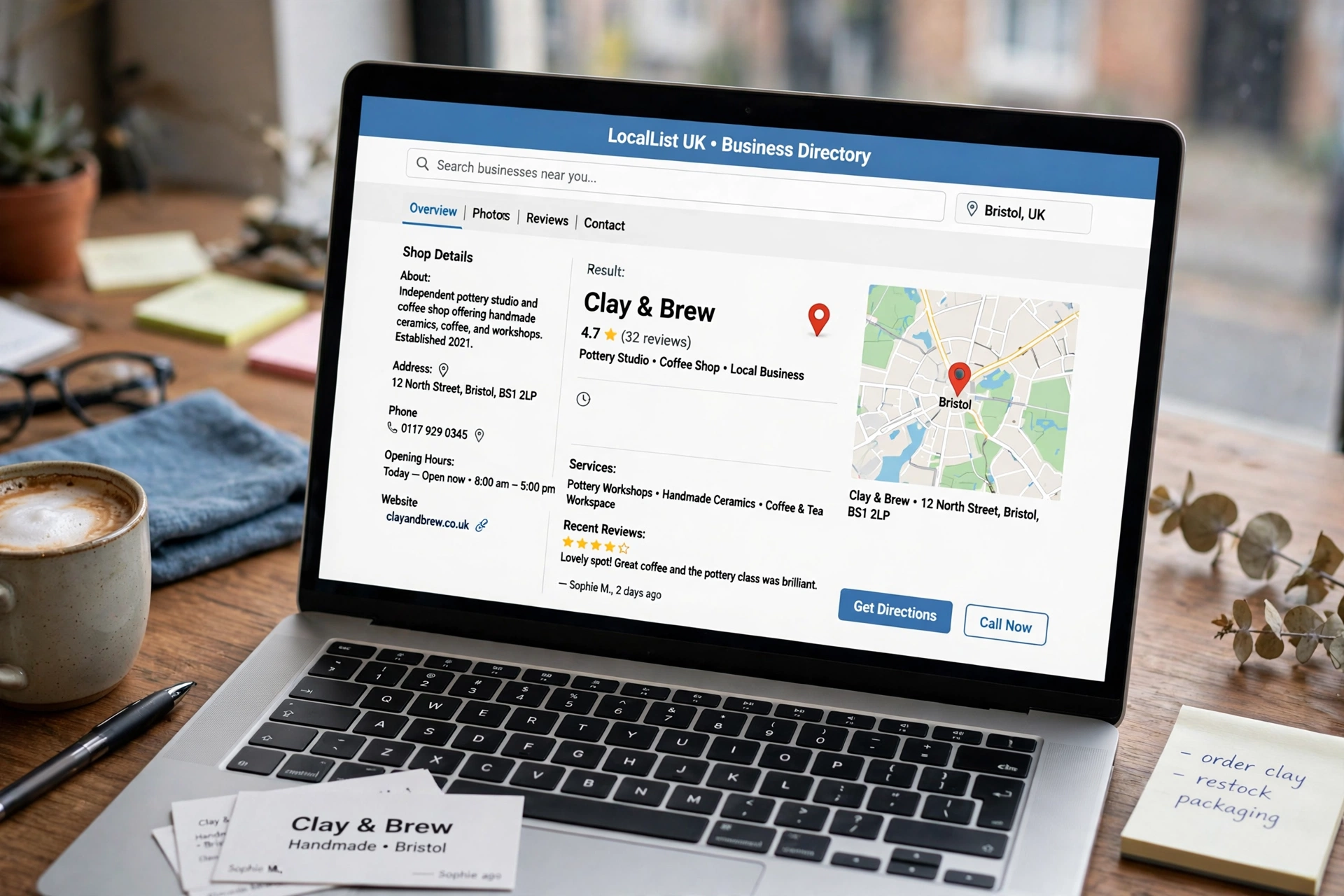
When a customer searches for a plumber in Leeds, a cafe in Bristol or a solicitor in Manchester, Google has to decide which businesses are real, which ones are nearby, and which ones are worth showing first. Your website helps, and your reviews help, but there is a third piece that many small businesses ignore: the listings of your business on other sites across the web. Those listings are called citations, and they still matter in 2026.
This guide explains what a citation is, why it matters for local search, where a UK small business should list, in what order, and how to keep your details identical everywhere so Google trusts what it sees.
Direct answer
A local citation is any mention of your business name, address and phone number online. List your business first on Google Business Profile, then on Apple Business Connect, Bing Places and the main UK directories, and keep your name, address and phone number identical in every listing so Google trusts your details.
What is a local citation?
A citation is any mention of your business name, address and phone number online, and NAP stands for Name, Address and Phone Number, per edgeoftheweb.co.uk. A citation does not have to include a link to your website. It only has to mention your business in a way Google can read.
There are two kinds. A structured citation is a listing with separate fields for name, address, phone, website, category and hours, while an unstructured citation is a mention in ordinary text such as a local news story or a supplier’s stockist list, per aiwebpageseo.com. A listing on Yell is structured. A mention in a local newspaper article that says you sponsored the village fete is unstructured. Both count, and both help Google confirm that your business exists and where it is based.
It helps to keep citations separate from backlinks in your mind. A backlink is a link from another site to yours, and it passes ranking value. A citation confirms your details, and many directory listings pass no link value at all. That does not make them useless. A citation with no link can still help local search, because it tells Google that your name, address and phone number are real and consistent.
Why do citations still matter in 2026?
Google names prominence as one of the things behind local results, per aiwebpageseo.com. Prominence means how well known a business is, and Google judges it partly by what it finds about the business across the web. A business with consistent listings on the main platforms, mentions in local news, and a listing in its trade directory looks more prominent than a business with one listing and nothing else.
Citations also feed the maps and assistants that customers now use instead of a search results page. When someone asks a phone for the nearest open cafe, or looks at a map for a garage, the answer comes from a mix of map data and directory listings. If your business is missing from the map platforms, it will not appear in those answers, no matter how good your website is.
There is a third reason. Citations help customers find you when your website is not the first thing they see. A customer who finds your Yell listing, your Facebook page or your Checkatrade profile can call you from there, without ever visiting your site. That call still counts as a lead, even though it never touched your website.
Citations will not save a business with a poor website, no reviews and no Google Business Profile. They work as part of a local setup, not on their own. But for a business that already has the basics in place, consistent citations are a simple, low cost way to strengthen the signal that you are a real business in a real place.
How do you get your NAP right first?
Before you list anywhere, write your details down once, exactly as they should appear, and use that version everywhere. This is called NAP consistency, and it matters more than the number of listings you build.
Your NAP is your business name, your address and your phone number. Decide the exact form of each one. Is your business called Smith Plumbing, Smith Plumbing Ltd, or Smith Plumbing and Heating? Is your address 12 High Street, or 12 High St? Is your phone number written with spaces in one place and without them in another? Pick one version of each and use it in every listing, on your website, on your Google Business Profile and on your social profiles.
Consistency matters more than quantity, per skillsandai.blogspot.com and dpom.co.uk. Ten listings with identical details help more than a hundred listings with three different spellings of your name, two different phone numbers and an old address mixed in. Inconsistent details confuse Google, and they confuse customers who try to call a number that no longer works.
Write your details down in a simple document. Include the exact business name, the full address with postcode, the phone number, the website address, the opening hours and the business category. Copy and paste from that document every time you create a listing. Do not retype the details from memory, because that is how small differences creep in.
A limited company must show its registered name, number, registered office address and place of registration on its website, per GOV.UK via digitalarchitect.in. That is a legal duty, not an SEO tip, and it is worth checking while you sort out your details. Your footer or contact page is the right place for it.
Where should a UK small business list first?
The aim is not the largest possible number of listings, it is presence on the handful of platforms that feed maps and assistants, the directories customers in your trade genuinely use, and the local sites that prove you are part of the community, per aiwebpageseo.com. List in the order below, and stop when you have covered the tiers that fit your business.
Start with your Google Business Profile, then Bing Places, Apple Business Connect, Yell, Thomson Local, Scoot, Cylex, FreeIndex and the relevant industry directories, per dpom.co.uk. That order is a good starting point, because it puts the map platforms first, where customers actually search, and the general directories next.
| Tier | Where to list | Why it matters |
|---|---|---|
| Tier 1, map platforms | Google Business Profile, Apple Business Connect, Bing Places for Business, your Facebook page | These feed maps, search and voice assistants directly |
| Tier 2, general directories | Yell, Yelp, FreeIndex, Thomson Local, Cylex, Hotfrog | Customers still use these to check a business before they call |
| Tier 3, trade directories | Checkatrade, TrustATrader, MyBuilder, Rated People, TripAdvisor, OpenTable | Customers in your trade trust these to find a supplier |
| Tier 4, local sources | Chamber of commerce, business improvement district, council business directory, local news, clubs and charities you support | These prove you are part of the local community |
Tier 1 map platforms are Google Business Profile, Apple Business Connect, Bing Places for Business and your Facebook page. Tier 2 general directories people still use are Yell, Yelp, FreeIndex, Thomson Local, Cylex and Hotfrog. Trade sites include Checkatrade, TrustATrader, MyBuilder or Rated People for trades and TripAdvisor and OpenTable for hospitality. Local sources include chamber of commerce, business improvement district, council business directory, local news and clubs and charities you support, per aiwebpageseo.com.
Your Google Business Profile is the first listing to get right, and it is the one that matters most. If you have not worked through it yet, read our Google Business Profile optimisation checklist. It covers categories, hours, photos, services and reviews, and it is the foundation every other citation builds on.
After the map platforms, add the general directories that fit your business. Yell is still the best known UK directory, and it is worth having a complete listing there. FreeIndex, Thomson Local, Cylex and Hotfrog are all useful, but check each one before you pay for anything. A free listing is enough to start. Do not pay for a premium listing on a directory until you know customers actually find you through it.
Trade directories matter most when your customers use them to choose a supplier. A builder who is not on Checkatrade or TrustATrader will lose work to builders who are, because customers check those sites before they call. A restaurant that is not on TripAdvisor or OpenTable will lose bookings in the same way. If your trade has a directory customers trust, list there, keep the profile complete, and ask happy customers to leave a review on it.
Local sources are the tier most businesses skip, and they are often the most useful for proving you belong in an area. Join your chamber of commerce if it has a member directory. Check whether your council has a business directory. If you sponsor a local club, support a charity or take part in a community event, ask the organiser whether they list supporters on their website. Those mentions are unstructured citations, and they carry weight because they are real, local and hard to fake.
What should you skip?
Not every directory is worth your time. The web is full of directories that exist only to sell listings, and they will not help your business or your search ranking. Skip any directory that asks for money before you have seen a single customer from it, any directory that lists thousands of businesses in every trade and every town with no real visitors, and any service that offers to list you on hundreds of directories for a fee.
Paying for hundreds of listings is a waste of money and a risk to your NAP consistency. Those services often create listings with slightly different details, and they create listings on sites that Google does not trust. A small number of accurate listings on real platforms is better than a large number of sloppy listings on sites nobody uses.
Skip directories that are not relevant to the UK, or not relevant to your trade. A US directory will not help a UK business, and a directory for restaurants will not help a plumber. Relevance matters for citations just as it does for links. If you want the fuller picture on links, read our guide on how to get backlinks for a new website, which explains the difference between a citation and a link and which link methods are safe for a new site.
Do not create duplicate listings for the same business on the same platform. A duplicate splits your reviews, confuses customers, and can cause Google to show the wrong listing. If you find a duplicate, claim it and ask for it to be removed or merged, rather than creating a new one.
How do you audit the citations you already have?
Most businesses already have citations they do not know about. Old listings from a previous address, a listing created by a supplier, a mention in a local paper, or a directory that copied your details from another site. The first job is to find them.
Search for your business name in quotes, together with your town, and look through the results. Then search for your phone number in quotes, on its own. The phone number search is often more revealing, because it finds listings that use an old business name or a slightly different spelling. Write down every listing you find, with its address, its details and whether it is correct.
Check each listing against your master document. Is the name identical? Is the address the same, including the postcode? Is the phone number the same? Are the opening hours correct? Mark each one as correct, wrong, duplicate or out of date.
| Audit result | What to do |
|---|---|
| Correct | Leave it alone and check it again in six months |
| Wrong details | Claim the listing and correct the name, address or phone number |
| Duplicate | Claim both listings and ask the platform to merge or remove one |
| Out of date address | Update it, or ask for removal if the business has moved |
| Listing you did not create | Claim it, so you control the details from now on |
Claiming a listing is usually free. The platform will ask you to verify that you own the business, often by phone, email or postcard. Once you have claimed it, you can correct the details and keep them up to date. If a platform will not let you claim a listing, contact its support team and ask for the listing to be corrected or removed.
How do you fix wrong listings and duplicates?
Fix the most important listings first. Start with Google Business Profile, then Apple and Bing, then the general directories, then the trade directories. A wrong address on Google will hurt you far more than a wrong address on a small directory, so fix the map platforms before you worry about the rest.
For each wrong listing, change the details to match your master document exactly. Do not change your master document to match a wrong listing. The master document is the source of truth, and every listing should match it.
Duplicates are common on Google Business Profile and on Yell. If you find two listings for the same business at the same address, do not delete one yourself if you can avoid it. Claim both, then use the platform’s own process to merge them or ask support to remove the duplicate. Deleting a listing that has reviews will lose those reviews, so merging is better when the platform offers it.
If a business has moved, update every listing, and do not leave the old address live anywhere. An old address on a directory will send customers to the wrong place, and it will confuse Google about where you are based. Update the website first, then Google, then the other platforms, in the same week if you can.
How often should you check your citations?
Citations do not need weekly attention, but they do need a regular check. Once every six months is enough for most small businesses, and once a quarter is better if you change your hours, your phone number or your services often.
Set a simple routine. Every six months, search your business name and phone number in quotes, check your Google Business Profile and your main directories, and correct anything that has changed. After any change to your address, phone number or opening hours, update your master document first, then update every listing within a week.
If you take on a new service, add it to your Google Business Profile and your trade directories. If you close for a holiday, update your hours on Google rather than leaving the old hours live. Small, regular updates keep your citations accurate, and accurate citations are the whole point.
Frequently asked questions
What is a local citation?
A citation is any mention of your business name, address and phone number online, per edgeoftheweb.co.uk. It can be a structured listing with separate fields, or an unstructured mention in ordinary text.
Are citations the same as backlinks?
No. A citation confirms your details, and many directory listings pass no link value at all. A backlink is a link from another site to yours, and it passes ranking value. Both help, but they do different jobs.
How many citations does a small business need?
There is no fixed number. Consistency matters more than quantity, per skillsandai.blogspot.com and dpom.co.uk. A small number of accurate listings on the map platforms, the main UK directories and your trade directories is enough to start.
Which citation should I fix first?
Your Google Business Profile. It feeds search and maps directly, and a wrong address or phone number there will hurt you more than a wrong detail on a small directory.
How do I find citations I did not create?
Search for your business name in quotes with your town, then search for your phone number in quotes on its own. Write down every listing you find, check it against your master details, and claim any listing you do not control.
Conclusion
Local citations are simple, unglamorous work, and that is why many businesses skip them. Write your name, address and phone number down once, exactly as they should appear, and use that version everywhere. List first on Google Business Profile, Apple Business Connect and Bing Places, then on Yell and the other main UK directories, then on the trade directories your customers trust, then on local sources that prove you are part of the community. Skip the spammy directories and the services that offer hundreds of listings for a fee. Audit what you already have, fix the wrong details, merge the duplicates, and check everything again every six months. It will not bring traffic overnight, but it will make Google more confident that your business is real, local and worth showing.